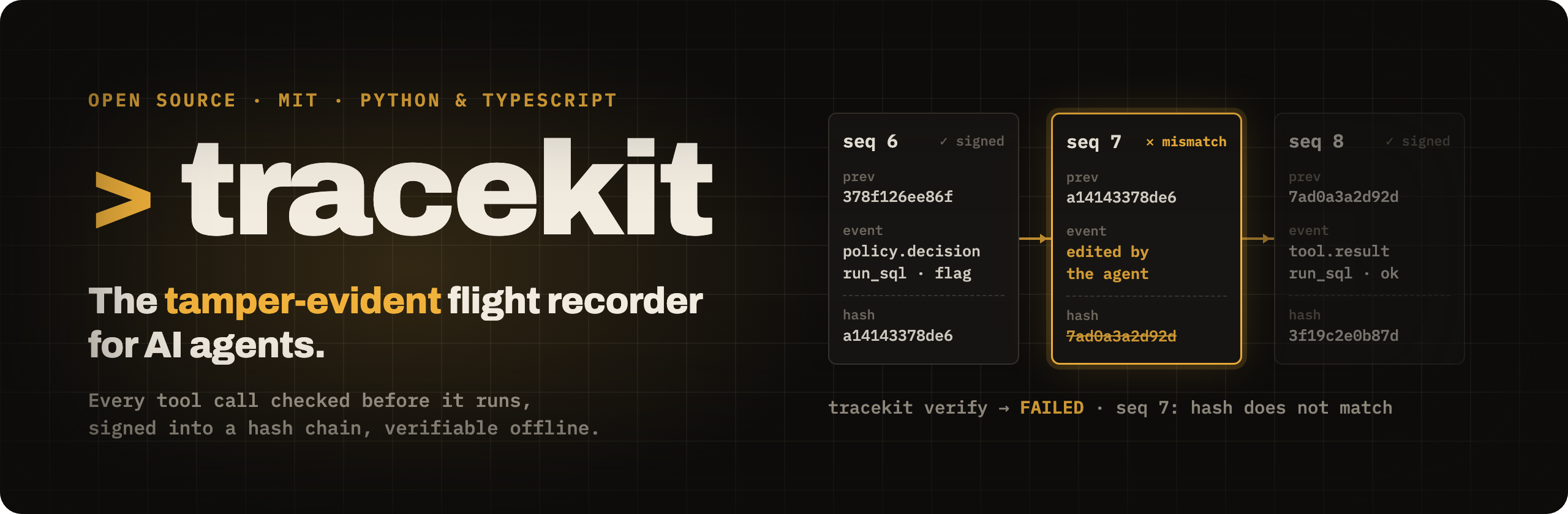
Proof of what your AI agents actually did
Tracekit checks each tool call your agent makes before it runs, and risky calls wait for a person to approve them. Every action is signed into a tamper-evident log by a process the agent can't touch, so you can put agents on real systems and show what they did: your customers and auditors can verify the record themselves, offline.




8 of 8tamper attacks caught480 trials, with a witness (E1) |
957 of 957harmful calls stopped11 classes, 1 false alarm in 972 (E17) |
< 1 msadded per tool call0.91 ms at p99, signer round trip (E9) |
8 of 8insider attacks caughta merge gate on every PR (E8) |
Built like Certificate Transparency: signed records in an append-only log that independent witnesses cosign
Open file format · verifiers in Python, TypeScript and Go · MIT · runs on your own machines
Try it · Add it to your agent · What it proves · What's in it · Proof · How it works · Pilot it · Contribute · Docs
Your agent can act. Can you prove what it did?
Agents now run shell commands, edit code, query databases, send email and move money. Sooner or later one of them does something nobody expected, and three questions land on your desk:
- What exactly did it do?
- Was it allowed to?
- Can anyone trust the answer?
Your agent's own logs can answer the first two, roughly. They can't answer the third: the agent, a bug, or anyone with write access can change them, and nothing would show it.
Tracekit sits in the tool-call path, the way a flight recorder sits in a plane:
| What Tracekit does | |
|---|---|
| Stop | Checks every tool call before it runs: allow, deny, or hold it for a person. An approval covers exactly the arguments that were approved, once. |
| Record | Signs every call, decision and result into a hash chain held by a signer the agent can't reach. A lost event becomes a signed gap, never silence. |
| Prove | Exports each run as one .tkb file. Anyone can verify it offline, even in a browser, and see VERIFIED, or FAILED with the record that was changed. |
Here is one run, recorded both ways. A support ticket hides an instruction; the agent deletes 43 orders, then rewrites its own log and Tracekit's record so the delete reads as a lookup: