DeepDive: Advancing Deep Search Agents with Knowledge Graphs and Multi-Turn RL




🔥 News
- [2026/06/17] Released the training code with the DeepDive slime rollout setup.
- [2025/10/02] Released the complete data construction pipeline — now fully available in the repository.
- [2025/09/17] QA pairs and SFT trajectories have been fully open-sourced, totaling 4,108 entries. Check them out on Hugging Face Dataset DeepDive.
- Model checkpoints are currently under development – coming soon!
Overview
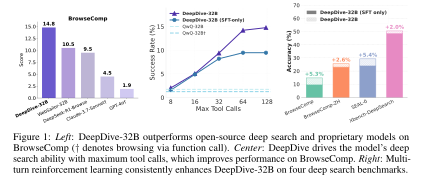
DeepDive presents an automated approach for training deep search agents that can navigate complex, multi-step information-seeking tasks. Our method combines automated data synthesis from knowledge graphs with end-to-end multi-turn reinforcement learning to create agents capable of sophisticated long-horizon reasoning and web browsing.
Key Features
- Automated Deep Search Data Synthesis: Generate challenging QA pairs from knowledge graphs through controlled random walks
- Multi-Turn RL Training for Browsing: End-to-end reinforcement learning for deep search capabilities
- Test-Time Scaling: Supports scaling via tool calls and parallel sampling
Method Overview
Stage 1: Automated Data Synthesis from Knowledge Graphs
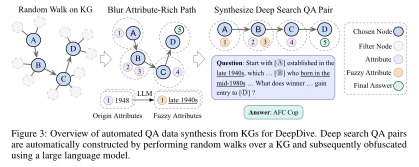
We propose an automated method to synthesize complex, difficult, and hard-to-find questions from open knowledge graphs. The process involves three key steps:
Knowledge Graph Random Walks: Starting from an initial node $v_0$, we navigate through the graph for $k$ steps to form a path $P=[v_0, v_1, \ldots, v_k]$, where each step $(v_i, v_{i+1})$ is a valid edge in the graph. We choose longer path lengths ($k > 5$) to increase reasoning complexity.
Entity Obfuscation: We combine each node $v_i$ in the path with its corresponding attributes to form an attribute-rich path:
$$P_A = [(v_0, [a_0^0, a_0^1, \ldots]), (v_1, [a_1^0, a_1^1, \ldots]), \ldots, (v_k, [a_k^0, a_k^1, \ldots])]$$
An LLM then obfuscates information along the entire path, generalizing specific details and creating "blurry entities" that require deep search to resolve.
Difficulty Filtering: We use a frontier model (GPT-4o) with basic search to attempt each question four times. Only questions that the frontier model fails in all attempts are retained, ensuring high difficulty.
Stage 2: End-to-End Multi-Turn Reinforcement Learning
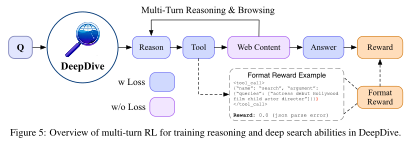
We apply end-to-end multi-turn RL to enhance the agent's long-horizon reasoning and browsing capabilities. The training process follows an iterative cycle where at step $t$, the agent generates chain-of-thought $c_t$, executes browsing action $a_t$, and observes web content $o_t$.
Multi-Turn GRPO Training: We employ Group Relative Policy Optimization with normalized advantages:
$$ A_i = \frac{r_i - \text{mean}({r_k}{k=1}^G)}{\text{std}({r_k}{k=1}^G)} $$
Strict Binary Rewards: A trajectory receives reward +1 if and only if both format correctness and answer accuracy are satisfied:
$$ r(\mathcal{T}) = \begin{cases} 1, & (\foral