
OpenAlice
Your one-person Wall Street.
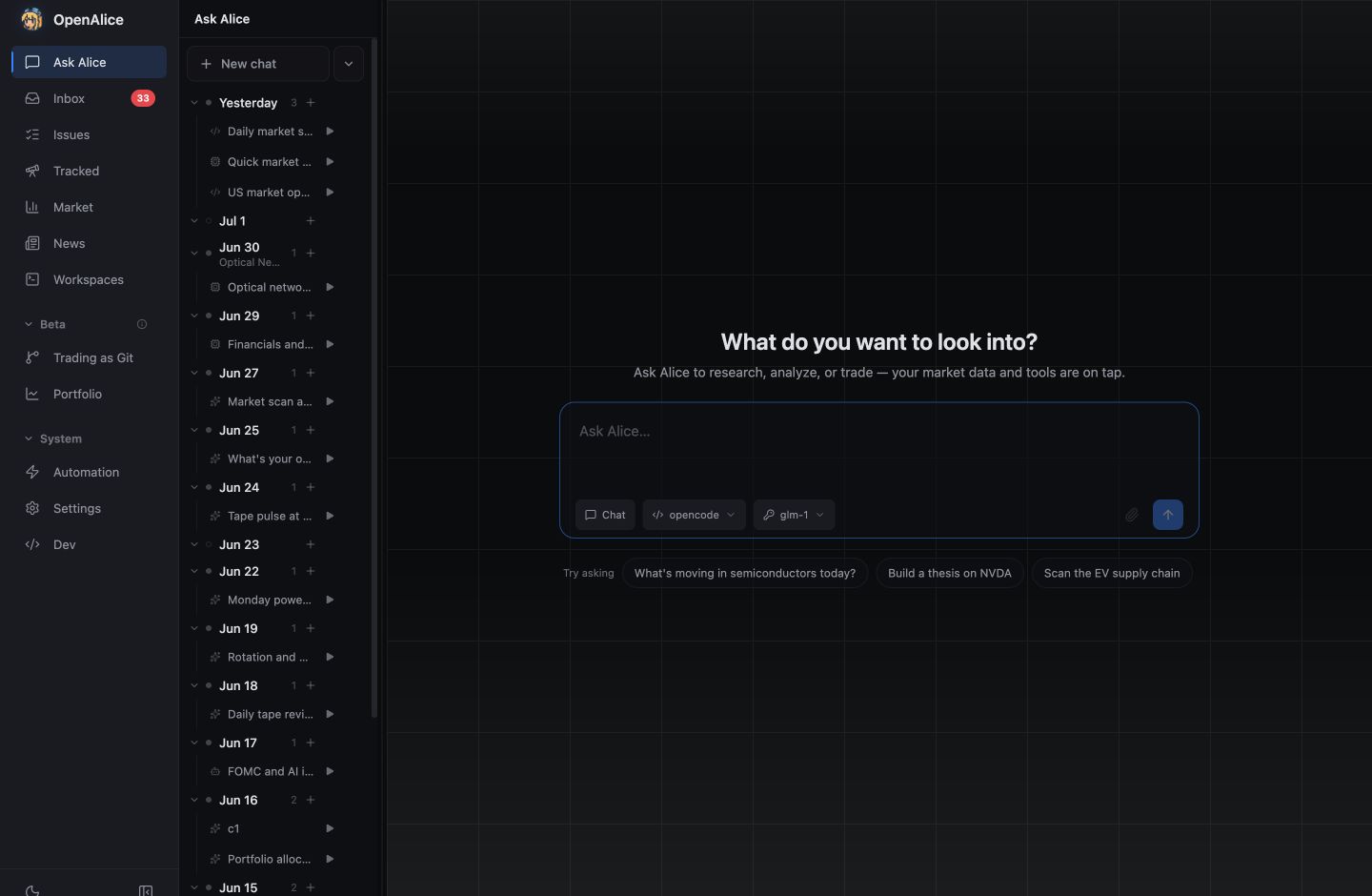
OpenAlice turns coding agents into local trading agents by giving them a workspace, files, issues, market tools, and approval-gated trading primitives.


[!CAUTION] OpenAlice is experimental software in active development. Many features and interfaces are incomplete and subject to breaking changes. The trading layer is especially beta. Do not use OpenAlice for live trading with real funds unless you fully understand and accept the risks involved. The authors provide no guarantees of correctness, reliability, profitability, or loss prevention.
What is OpenAlice?
OpenAlice is a local trading workspace for coding agents.
The core idea is simple: coding agents became useful quickly because software work already has a collaboration substrate. Code has git, issues, markdown docs, review workflows, linters, terminals, logs, and reproducible project folders. A coding agent can enter that world and immediately understand how to inspect, modify, review, and report work.
Trading usually does not have that shape. A trader may read news, browse charts, hold broker positions, and keep private notes, but the work is rarely organized as a collaborative system that a human and multiple AI agents can share.
OpenAlice tries to make trading agent-operable by mapping trading work onto the tools coding agents already understand:
- Workspaces - each serious task gets a directory, git repo, terminal session, and native agent CLI.
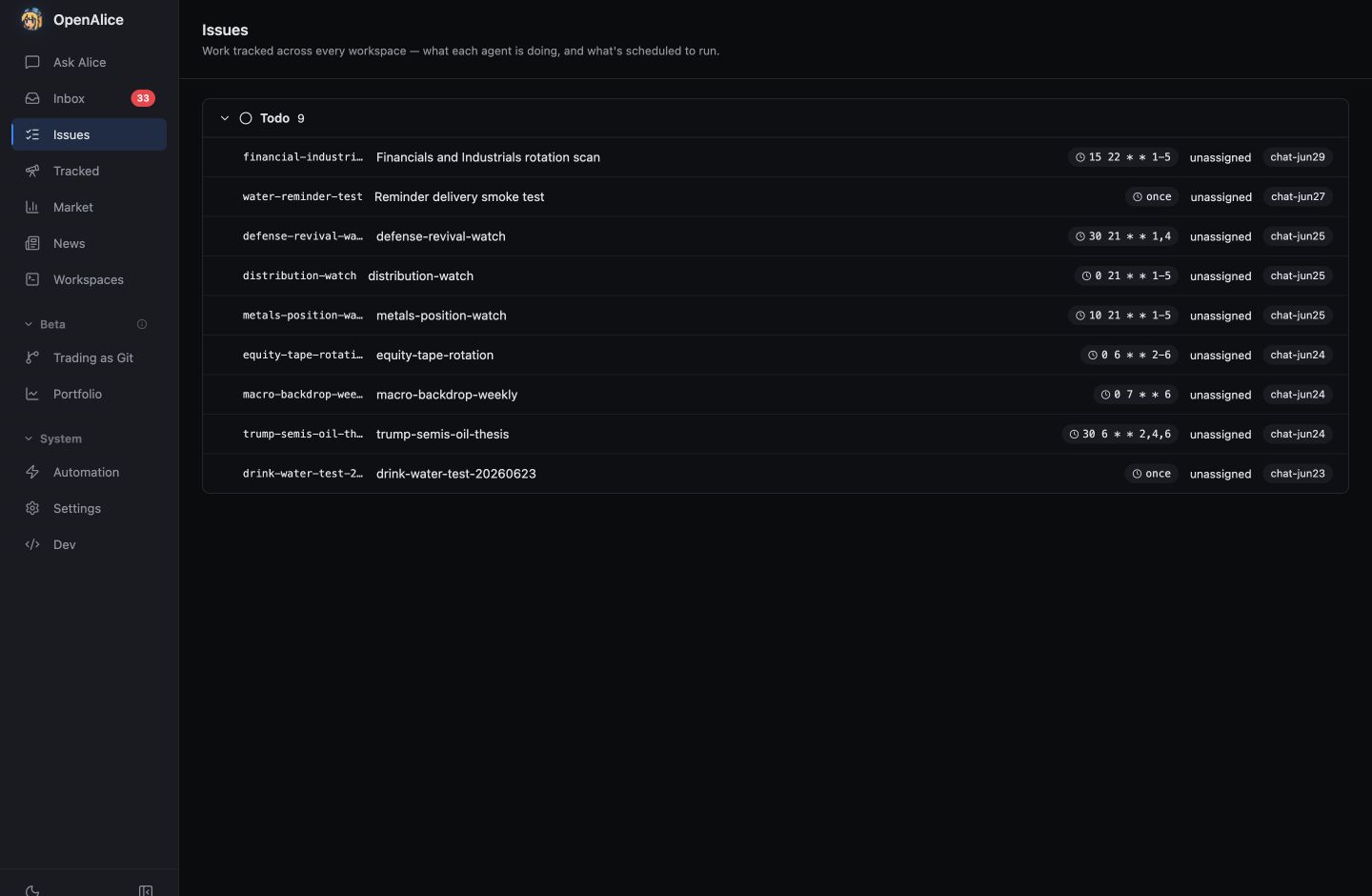
- Issues - trading work becomes self-describing markdown tasks, similar to Linear tickets.
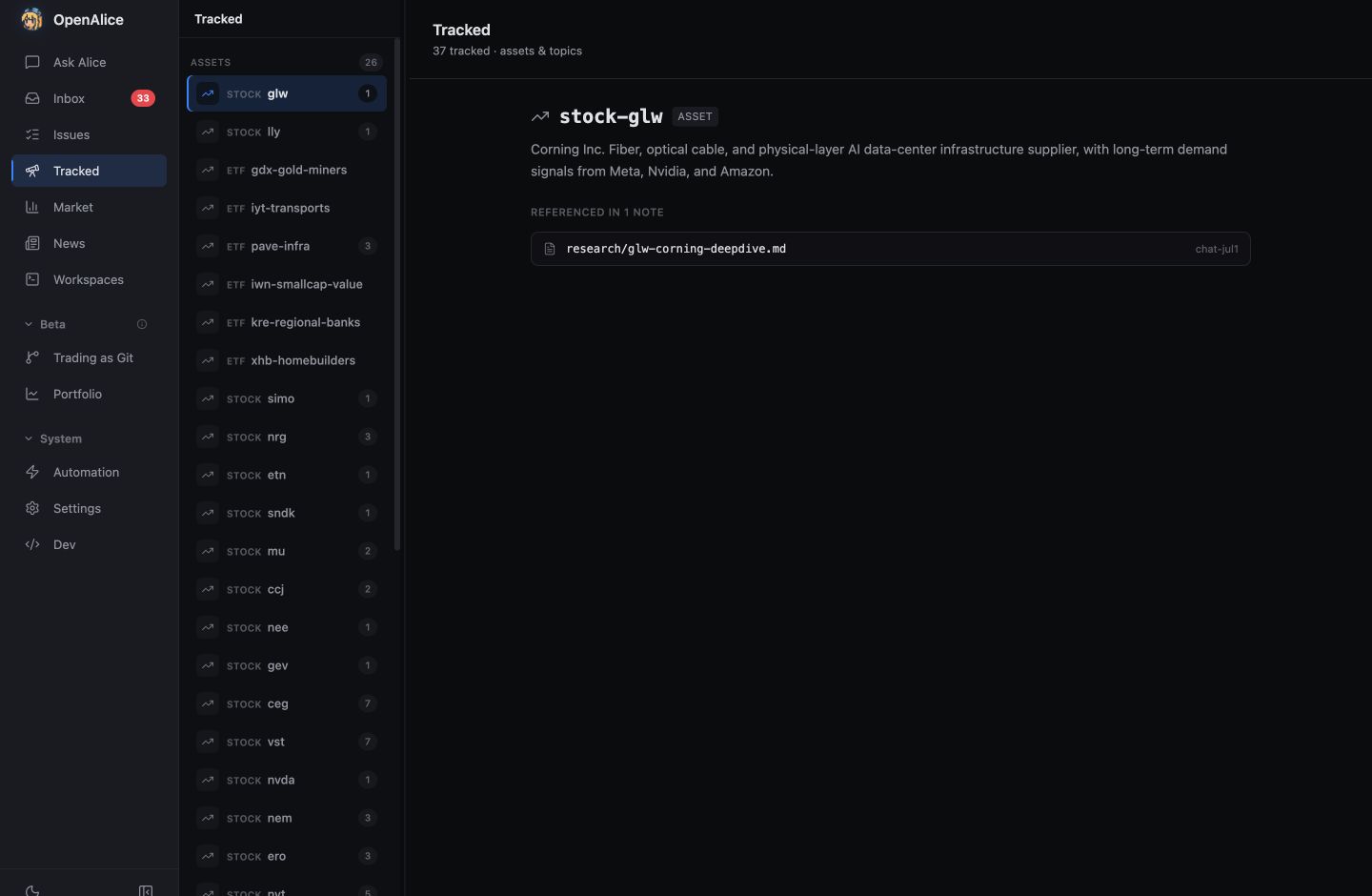
- Tracked entities - assets, sectors, topics, theses, and people become an Obsidian-like memory graph.
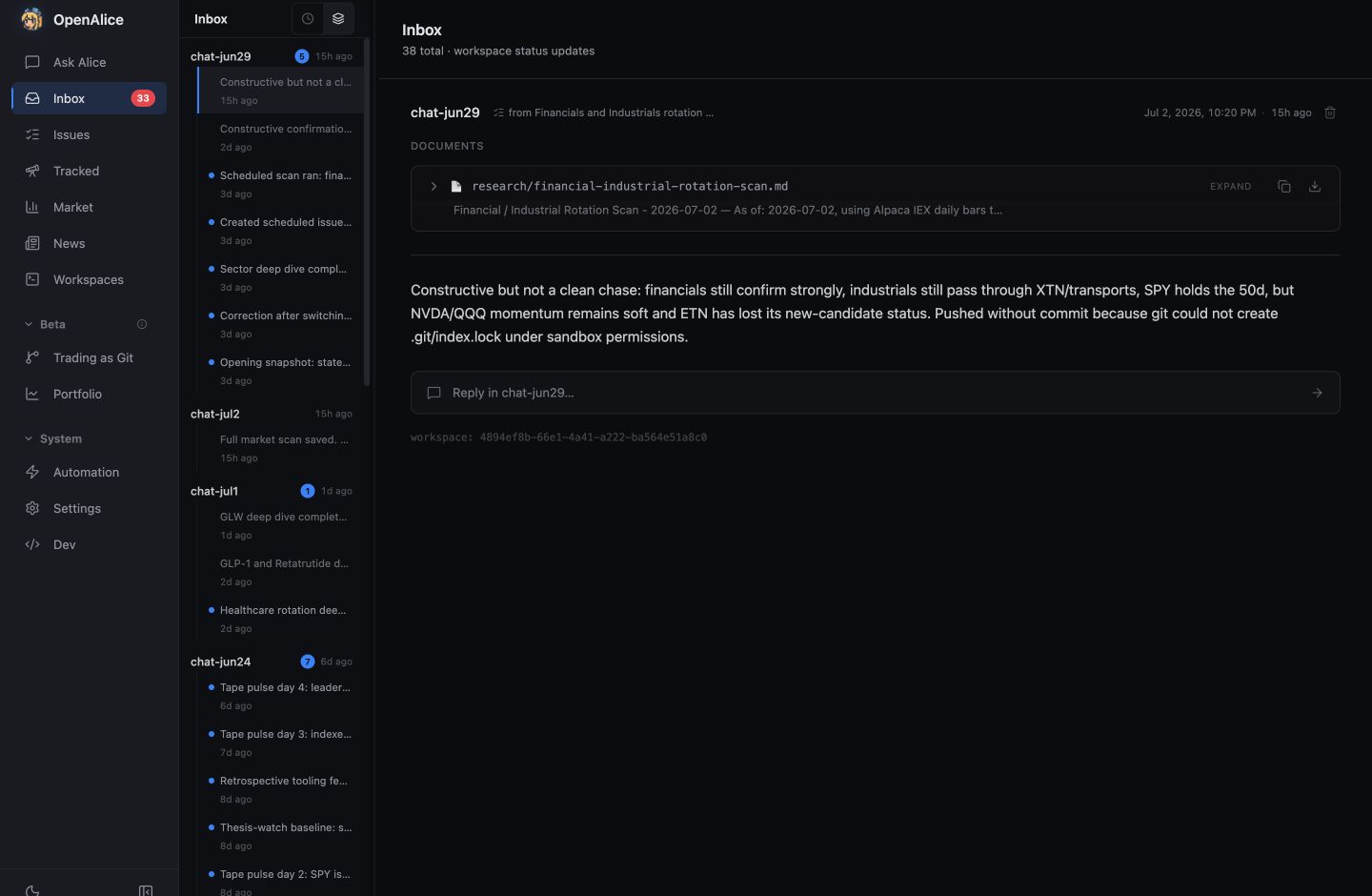
- Inbox - finished work is delivered as durable reports instead of disappearing into chat history.
- Market tools - data, news, fundamentals, technical analysis, and trading account state are exposed through CLIs and local tools.
- Trading as Git - optional account actions are staged, committed, reviewed, and pushed through an approval gate.
OpenAlice does not replace Claude Code, Codex, opencode, Pi, or other coding agents. It gives them a trading-shaped place to work.
The Core Loop
Start with read-only research. You do not need a broker account to get value from OpenAlice.
- Ask Alice for a market question, company overview, sector scan, or thesis check.
- Track what should persist as entities and
[[wikilinks]]. - Create an issue when the work should continue, recur, or be handed to an agent later.
- Schedule the issue by writing timing and instructions into the same markdown file.
- Read the result in Inbox when the agent has something worth showing you.
 |
 |
| Issue Board | Tracked Entities |
 < <
|