
Scaling Harness Intelligence via Just-in-Time Harness Evolution




What is JIT-Agent?
JIT-Agent is a compact meta-agent that writes your agent harness on the fly. Instead of precompiling one general-purpose scaffold and hoping it transfers, JIT-Agent takes a task spec, a protocol, a tool/skill registry, and a few retrieved prior harnesses, and emits an executable, task-specific harness that wraps any off-the-shelf agentic LLM — Model-as-a-Harness.
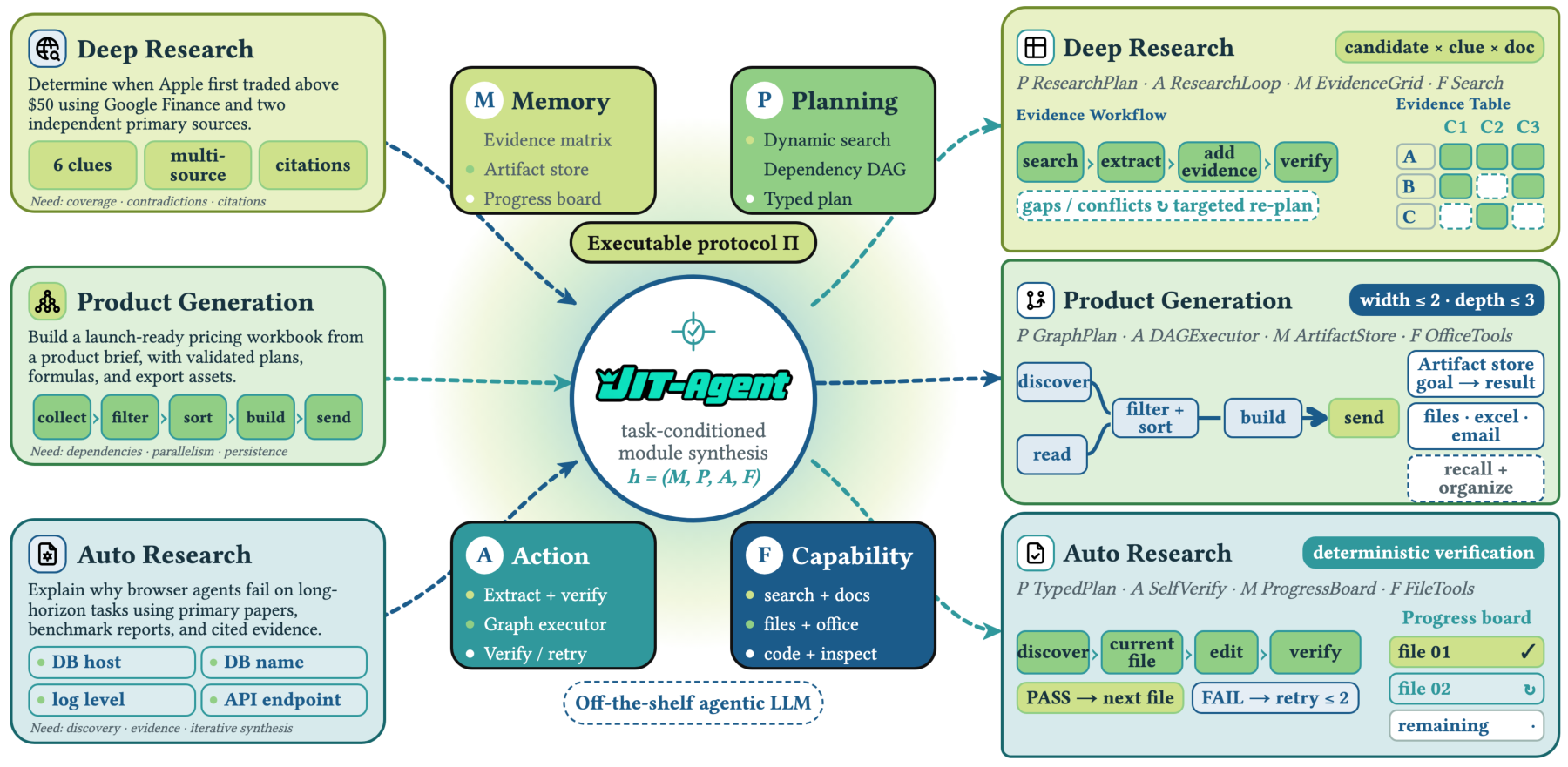
Every harness is factored into four modules — memory, planning, action, capability orchestration — implemented against the shared interfaces in HarnessFactory, so generation means emitting structured code rather than free-form agent programs. As traces and feedback come back, JIT-Agent revises the harness and updates the archive: harnesses keep improving at test time while the generator itself stays frozen.
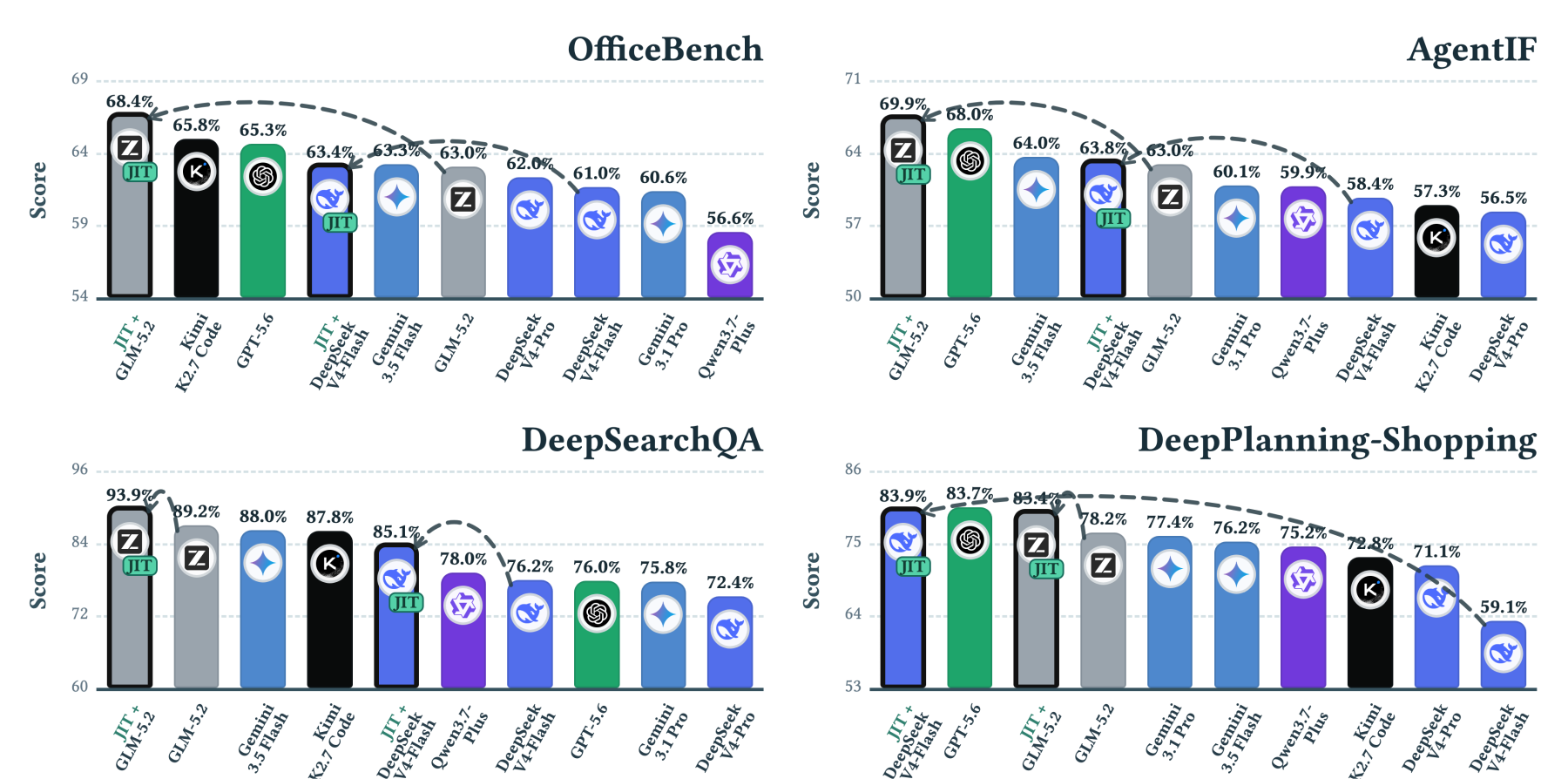
Results. The resulting JIT-Agent-27B lifts a wide range of backbone agents across deep research, daily work, planning, and workspace tasks.
Building the scaffold turns out to be a trainable, transferable axis of agent intelligence — orthogonal to scaling the base model.
Repository layout
| Directory | What it holds |
|---|---|
jit/ |
The meta agent: generation / repair prompts, best-of-N selection |
scripts/ |
The agent kernel, tools, models, evaluation engine, and the two runners |
harness_factory/ |
Hand-written harness implementations and their design write-ups |
benchmark/ |
One adapter, config and evaluator per benchmark |
dataset/ |
The benchmark data itself |
Each directory has its own README with the details.
Setup
1. Clone the repository
git clone https://github.com/bingreeky/JIT.git
cd JIT
2. Environment (Python 3.11)
conda env create -f environment.yml && conda activate jit
or, in an existing environment: pip install -r requirements.txt. Serving a local meta
model (vLLM/SGLang + torch) is deliberately not included — the pipeline only ever talks
HTTP to it.
3. Credentials
cp .env.example .env # then fill it in
Anything already exported in the shell wins over .env, and every model role can also be
overridden per run on the command line.
| Group | Keys | Used for |
|---|---|---|
| Execution model | OPENAI_API_BASE, OPENAI_API_KEY, EXEC_MODEL |
runs the generated harness's agent loop |
| Judge model | JUDGE_MODEL, optional JUDGE_API_* |
grades produced artifacts (falls back to the execution endpoint) |
| Meta model | META_MODEL, META_API_BASE, META_API_KEY, META_TOKENIZER |
writes the harness (JIT pipeline only) |
| Tools | SERPER_API_KEY, JINA_API_KEY |
`web_s |