The Most Powerful Deep Research Harness




Hyperresearch turns Claude Code into a deep research agent: one that currently leads the DeepResearch-Bench RACE leaderboard (benchmarked internally). A tier-adaptive 16-step pipeline takes one prompt and produces an adversarially-audited report with full source provenance. Every source it reads lands in a persistent, searchable vault, so each session starts smarter than the last.
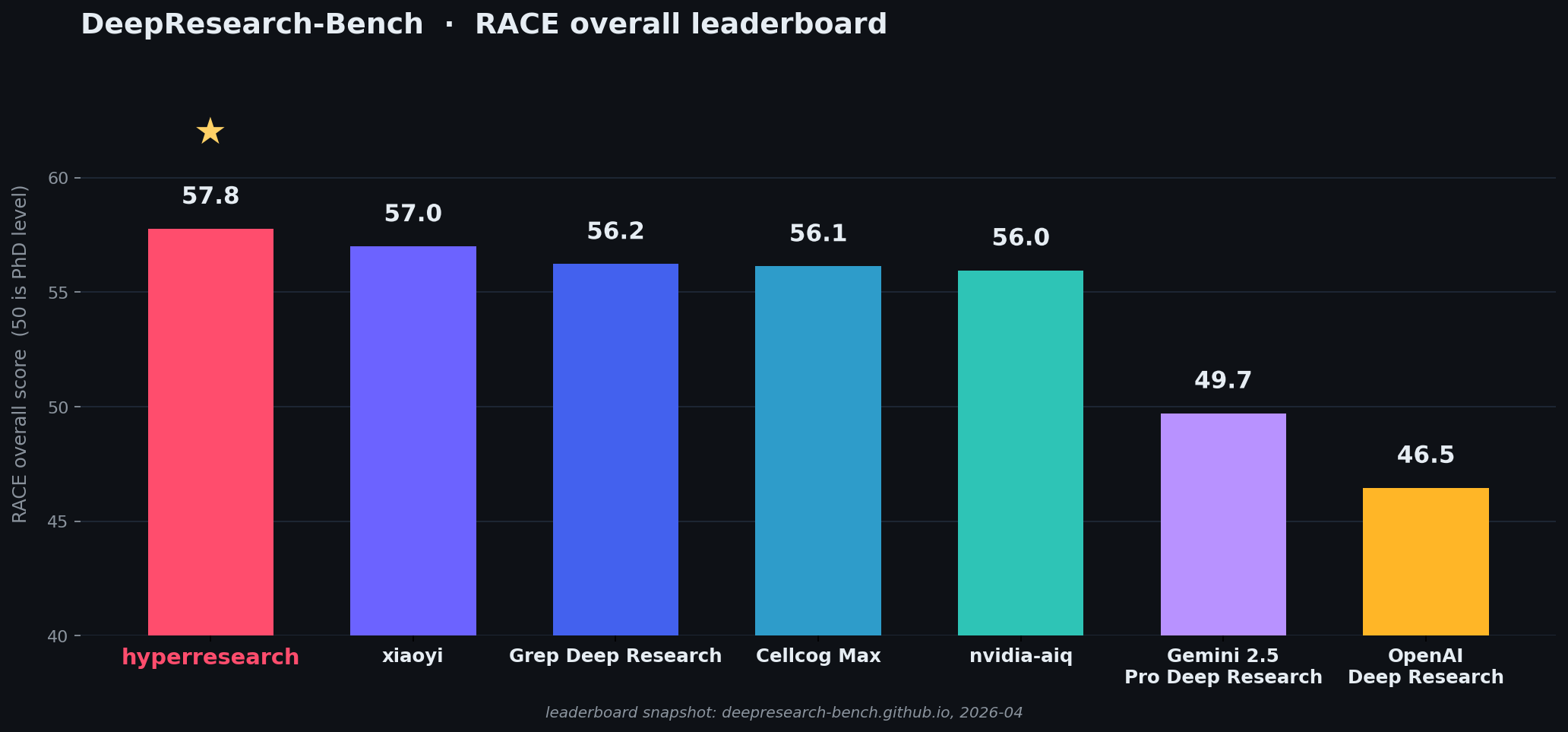
Forward-looking projection from a stratified pilot against the DeepResearch-Bench leaderboard snapshot (https://huggingface.co/spaces/muset-ai/DeepResearch-Bench-Leaderboard). Third party validation is pending.
Why it wins
- 250+ sources in a single run. The
premierscale profile targets 100–130 in the width sweep alone; citation chasing and gap-fill fetches more than double what actually lands in the corpus. - Every citation is verified before the report ships. A skeptical cite-checker audits whether each cited source actually supports its sentence. Hallucinated quotes and unacknowledged retractions are hard blocks at the gate.
- Syndication doesn't count as consensus. An independence audit clusters derivative copies, so five reprints of one press release argue with the weight of one source.
- Adversarial by construction. Four critics attack every draft in parallel, and a tool-locked patcher can only apply surgical edits. It physically cannot rewrite the report.
- Eight scholarly sources, one query.
hpr scholar searchhits OpenAlex, Crossref, CORE, DOAB, ClinicalTrials.gov, SEC EDGAR and FRED through one client layer and returns a single list deduplicated by DOI and title. Books, trials and filings come back alongside papers, each tagged so the pipeline knows which is which. The humanities and social sciences are covered on purpose, not as an afterthought. - Paywalled papers get read, not skimmed. A closed paper normally enters a vault as a 1,500-character abstract that the report then cites as though it had been read. Hyperresearch asks Unpaywall, Europe PMC and CORE for a legal open-access copy and stores the full text instead, even when the publisher blocks the fetch outright. Every substitution is disclosed in the note, the frontmatter, and the CLI output.
- Nothing is thrown away. Every source lands in a searchable markdown-plus-SQLite vault that your next session reuses before it fetches anything new.
- Crashed runs resume. Each run keeps a manifest;
run resumepicks up at the exact step where it died. - Scales from 30 minutes to a dissertation. Bounded queries auto-route to a 5-step fast path. Opt-in dissertation runs write 25K–80K words across chapters, from 300–450 sources.
Install
cd your-project
pip install hyperresearch && hyperresearch install
Then /hyperresearch <anything> in Claude Code.
Python 3.11–3.13. (3.14 not yet supported. Use
pyenv install 3.13,uv venv -p 3.13, or `py -3.