README.md2 min read
Council of High Intelligence
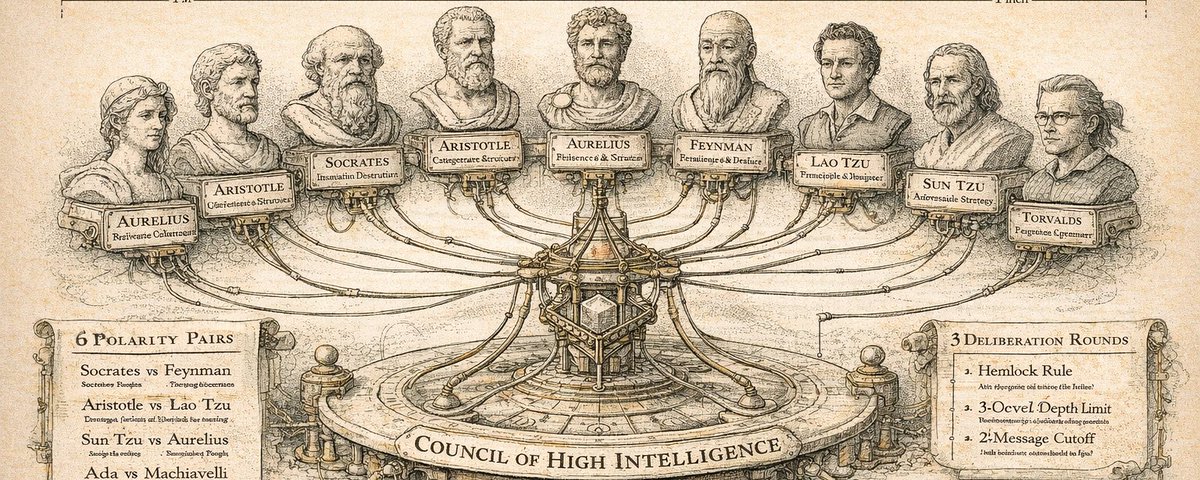
18 AI personas deliberate hard decisions. Structured disagreement, one command.


Claude Code · Codex · Gemini CLI
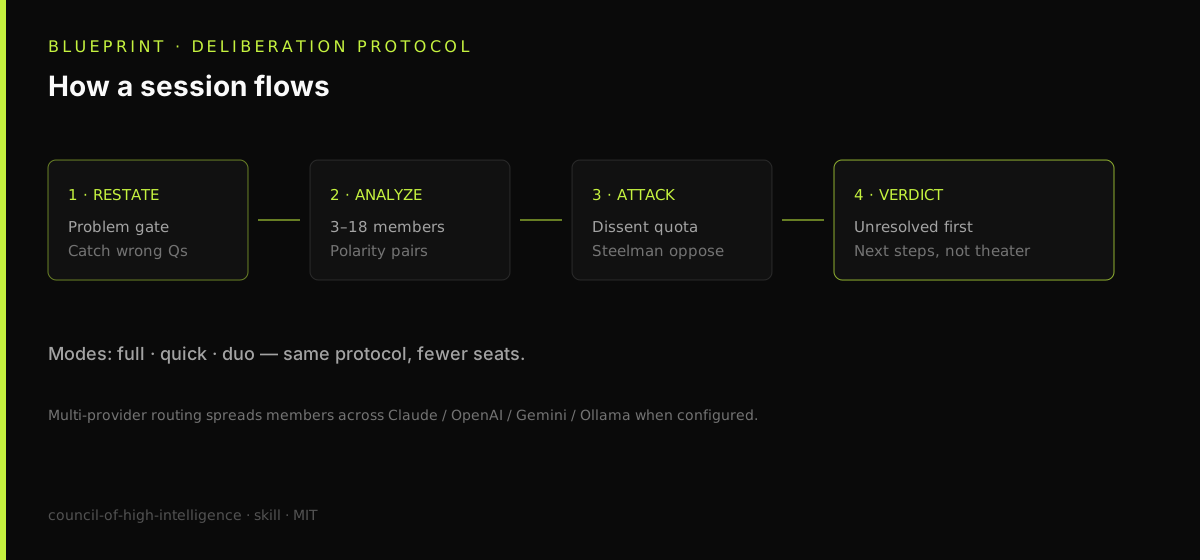
Table of Contents
Quickstart
Claude Code (plugin, recommended)
/plugin marketplace add 0xNyk/council-of-high-intelligence
/plugin install council@council-of-high-intelligence
Or via installer:
git clone https://github.com/0xNyk/council-of-high-intelligence.git
cd council-of-high-intelligence
./install.sh
Then in Claude Code:
/council Should we open-source our agent framework?
/council --quick Should we add caching here?
/council --duo Should we use microservices or monolith?
Codex
git clone https://github.com/0xNyk/council-of-high-intelligence.git
cd council-of-high-intelligence
./install.sh --codex
Gemini CLI
git clone https://github.com/0xNyk/council-of-high-intelligence.git
cd council-of-high-intelligence
./install.sh --gemini
The same /council commands work in all three hosts.
Why This Works
A single LLM gives you one reasoning path dressed up as confidence. Ask it a hard question and you get a fluent, structured, wrong answer. The council gives you structured disagreement instead.
- Genuinely different perspectives. Polarity pairs force real tension: Socrates destroys assumptions, Feynman rebuilds from first principles. Multi-provider routing spreads members across Claude, OpenAI, Gemini, and Ollama, so the reasoning actually differs rather than putting one model in eighteen costumes.
- Wrong questions caught early. The Problem Restate Gate makes every member reframe the question before analysis begins. When three members restate your question three different ways, the question was the problem.
- An honest map of the gaps. Verdicts lead with Unresolved Questions and Recommended Next Steps rather than confident-sounding consensus. What the council cannot settle matters more than where it happens to agree.
- Groupthink actively suppressed. Dissent quotas, novelty gates, and counterfactual prompts enforce disagreement. If agreement passes 70% too early, two members are conscripted to steelman the opposing view.
Why not just ask Claude directly? One prompt buys one model's confident best guess. The council runs 3 to 18 independent analyses from different intellectual traditions, forces them to attack each other's claims, and synthesizes a verdict that surfaces the disagreement instead of smoothing it