Old Coder skill(老码农 skill)
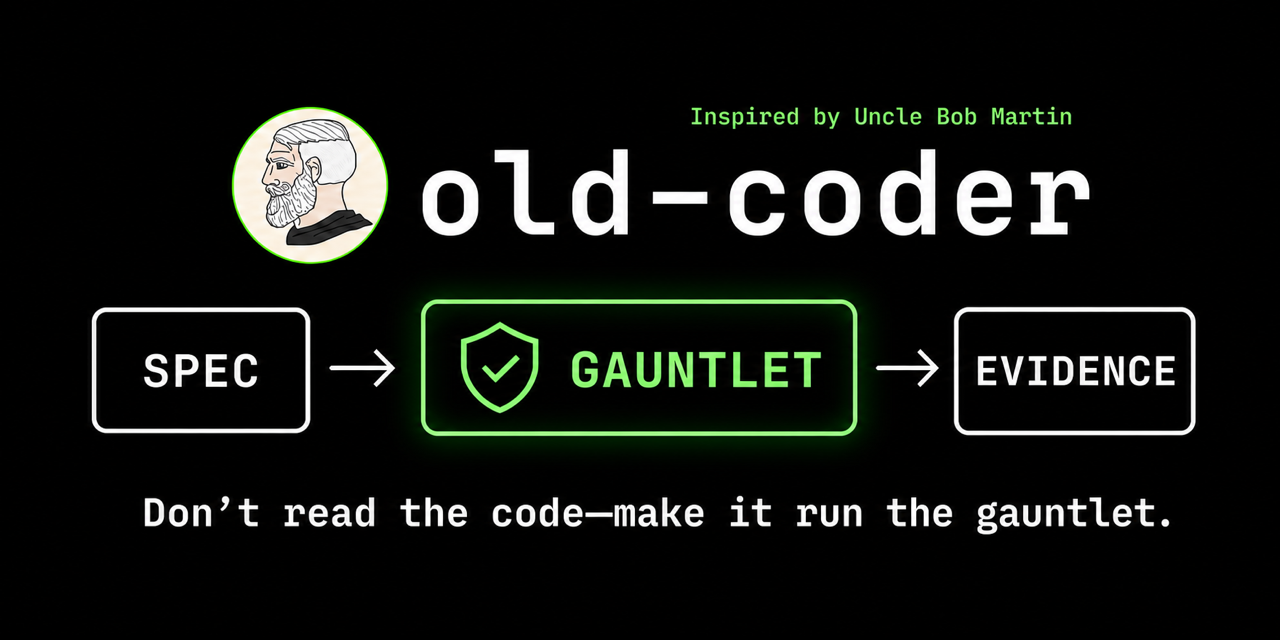
An old coder's strategy for the agent era: don't read the code — make it run the gauntlet.
A skill that makes coding agents prove their work. Instead of you reading every line, the agent pushes its code through a gauntlet of checks and hands you a test plan before coding and an evidence report after. You review those two documents, not the code.
It's plain markdown, so it works with any coding agent that follows instructions: Claude Code, Codex CLI, Cursor, Aider, or your own agent loop.
Installation
Install old-coder:
npx skills add https://github.com/amazingang/old-coder --skill old-coder
Or manually:
- Claude Code — copy the skill into a skills folder, then invoke
/old-coderor let it trigger on high-assurance requests:cp -r skills/old-coder ~/.claude/skills/ # or copy it to <project>/.claude/skills/ - Other agents — add
skills/old-coder/SKILL.mdto yourAGENTS.md, rules file, or system prompt, and keep itsreferences/directory alongside it.
Optional companion: old-coder-api
This repository also includes a focused HTTP/JSON API design and review skill. Install it when you want compatibility, authorization, idempotency, pagination, rate-limit, and operability gates:
npx skills add https://github.com/amazingang/old-coder --skill old-coder-api
To install both skills:
npx skills add https://github.com/amazingang/old-coder --skill old-coder --skill old-coder-api
When both apply, old-coder owns workflow, approval, and evidence; old-coder-api owns the API contract, and its gate decisions become SPEC constraints and gauntlet checks.
The idea
From Uncle Bob (Robert C. Martin), on working with coding agents (original tweet):
My current strategy is to not read any of the code written by my agents. That’s the only way I can take advantage of their productivity. What I do instead is to surround the agents with extreme constraints. Unit tests, gherkin tests, QA procedures, quality metrics, mutation testing, test coverage, and a plethora of others. In the end, I have very high confidence in the code they produce because they’ve had to run the gauntlet of all of my constraints and tests.
If you're not going to read the code, the things you do read have to carry the trust instead.
How it works
flowchart LR
    SPEC["📋 SPEC<br/>agent writes a test plan,<br/>you approve it"]
    RED["🔴 RED<br/>write a test,<br/>watch it fail"]
    GREEN["🟢 GREEN<br/>write code until<br/>it passes"]
    REF["🧹 REFACTOR<br/>clean up,<br/>tests untouched"]
    G["🛡️ GAUNTLET<br/>run every check"]
    EV["📊 EVIDENCE<br/>you read the report,<br/>not the code"]
    SPEC --> RED --> GREEN --> REF --> G --> EV
    REF -. next behavior .-> RED
You read two documents:
- SPEC (before any code) — concrete examples of what the code must and must not do, plus which tools the agent wants to install. Approving it is the single yes/no you give.
- EVIDENCE (after the code) — real numbers from one final fresh run, rerunnable yourself with a single command.
The gauntlet in between:
| Check | The question it answers |
|---|---|
| Full test suite | Did anything break? |
| Types + lint + complexity | Any obvious mistakes? Any unreadable tangles? |
| Changed-line coverage | Is every new line actually exercised by a test? |
| Mutation testing | Plant bugs on purpose — do the tests catch them? |
| Property-based tests | Do the rules survive hundreds of random inputs? |
| Real execution | Does it actually run, outside the test harness? |
| Supply chain & secrets | Did the agent quietly pull in risky packages, or leak a key? |
| Suite health | Are the tests themselves stable, in any order? |
Plus a menu of do