Turbocharge Claude Code, Cursor, Codex, Gemini & every coding agent: faster, cheaper, with contextual understanding specific to your codebase.








Up to 4× cheaper and 3× faster, with better or no loss of correctness.
| vs. a standard session, no Graft | With Graft |
|---|---|
| Tool calls | 46% fewer |
| Tokens | 42% fewer |
| Time | 60% less |
| Correctness | equal |
The table is a 162-run controlled benchmark (same agent, same file tools, only the context differs). The "up to 4× cheaper / 3× faster" figures are the biggest single-task wins from a separate real-repo sweep (PocketBase, ollama, Excalidraw). Full method & per-repo numbers ↓
Contents
- Quick start
- The problem
- What Graft does
- How the graph gets built
- What's in a node
- What runs where
- Agent integration — MCP server · Claude Code (deep integration)
- CLI
- Search & orient (
graft grep/graft map) - Monorepos & multi-repo folders
- Visualize it (
graft viz) - Benchmark
- Tested on your popular repos
- Development
- License
Quick start
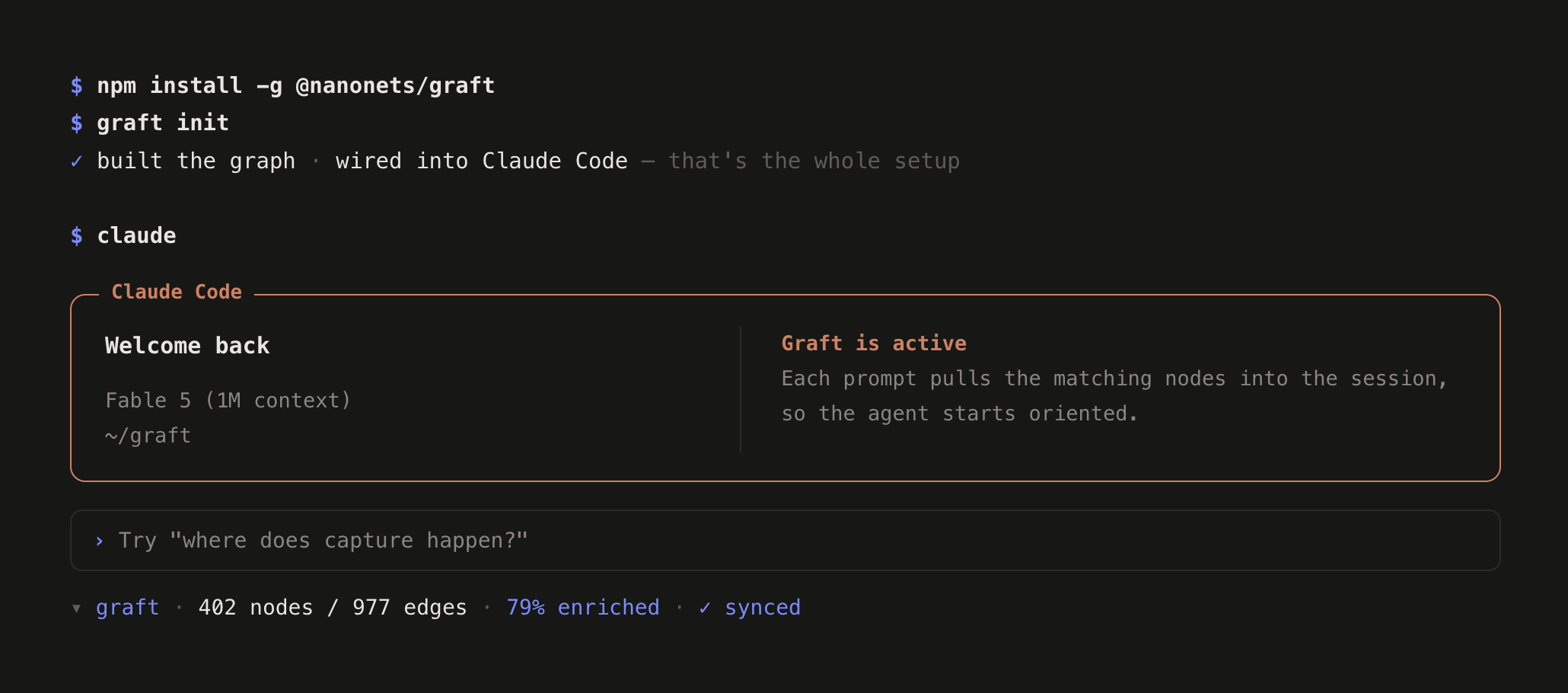
npm install -g @nanonets/graft   # install the CLI, once
graft init                       # build the graph + wire it into Claude Code
That is the whole setup. graft init asks which of your coding agents to wire up, builds graft/ from your code, and drops a statusline and hooks into .claude/, so from the next session on Graft rides along in Claude Code: it pulls the matching nodes into each prompt and rebuilds the graph in the background after every turn. No daemon, no re-indexing to remember, nothing to run or maintain by default — the graph is just files.
Nothing is written until you pick. Run graft init --dry-run to see every file it would touch first, or graft init --agents claude to skip the prompt and wire Claude Code alone.
graft build adds graft/ to your .gitignore automatically — the graph is a local, regenerable cache (like node_modules), not something you commit. What you share is the wiring init dropped into .claude/; each teammate runs `graft bui