Ontology Atlas

Understand what your codebase builds, why it is structured that way,
and what a change will affect.
Download for macOS · Windows x64 beta
Windows is a public, unsigned beta. Microsoft Defender SmartScreen may warn about an unknown publisher, and managed work PCs may block it.
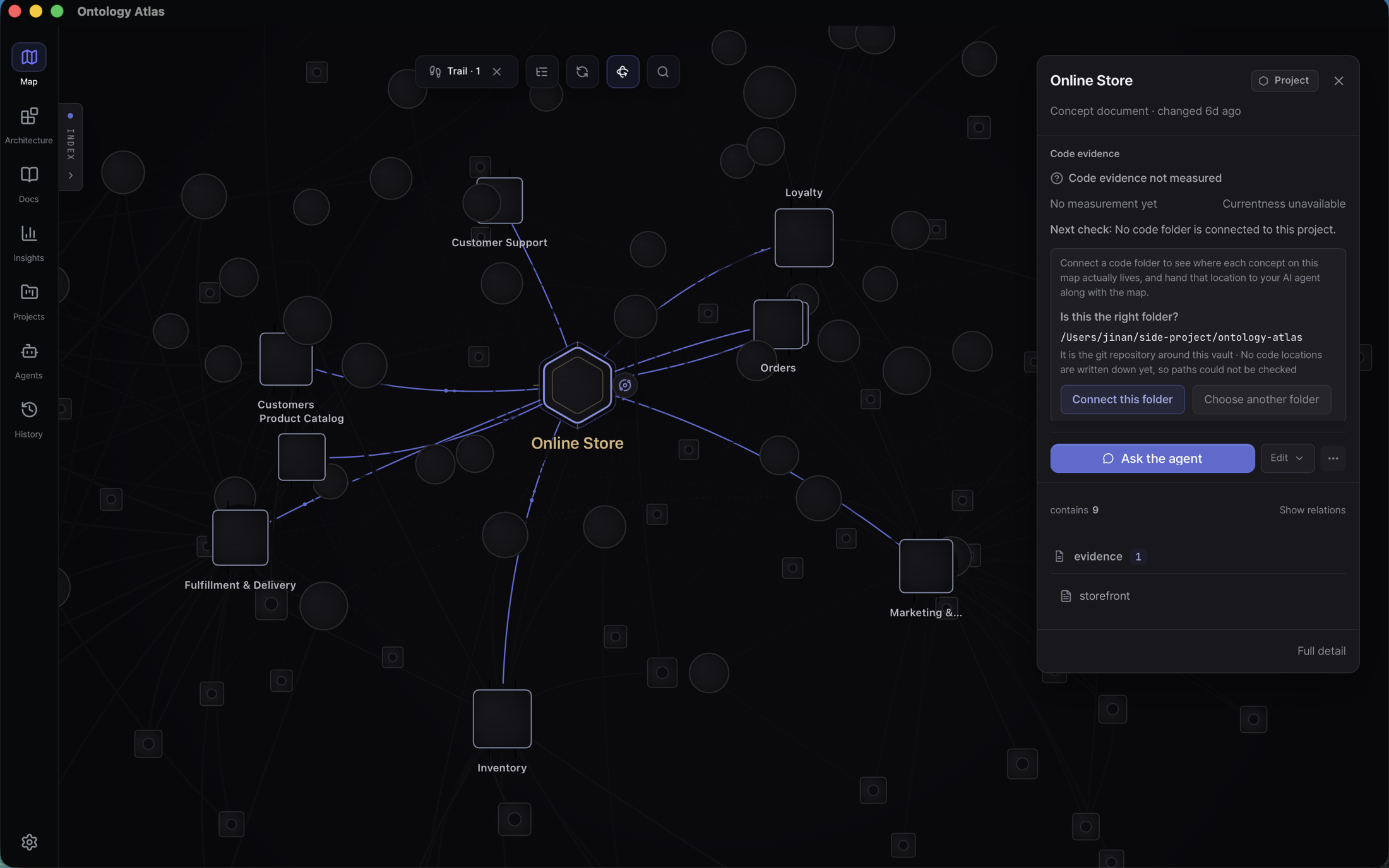
The installed macOS app reading the example vault in
samples/storefront — an online
store, written as nothing but Markdown files in a folder. The live demo and
feature inventory are the current behavior
contract.
Ontology Atlas keeps that explanation as a codebase ontology in repository Markdown: product domains and capabilities linked to implementation evidence, dependencies, and impact. People judge the files and git diffs; AI agents query and maintain the same ontology over MCP.
Each desktop download includes the Atlas app and its MCP server.
One button writes the connection files; the restart and mcp-verify
steps then prove the live connection from your agent's working folder.
Live demo · Guide · The journey · Where it stands · What this is not · Status




In 30 seconds
Source code shows how a system works. It rarely preserves which product
capability the code serves, why its boundaries exist, or what a change could
affect. Atlas keeps those answers beside the code, in an atlas/ folder of
Markdown files inside the repository itself — so the meaning is cloned,
branched, reviewed, and shared with the code rather than alongside it.
Use Atlas before a change so a person and an AI agent start from the same answer: what the code is for, where to begin, what else it touches, and what to verify. That answer stays bounded — a list of observed capabilities is not treated as exhaustive, and unsupported scope remains visible uncertainty.
Each file's frontmatter declares what it is (project, domain, capability,
element, or a linked document) and what it points at. That folder is the
whole database.
Because the kinds and relation types are a small fixed set, the folder is not just readable — it is computable. Atlas compiles it into a graph and answers questions a note-taking tool cannot: *what breaks if I change this, what is this capability's