
govctl






A governance harness for AI coding.
Turn prompts and patches into RFCs, ADRs, work items, and guarded delivery.
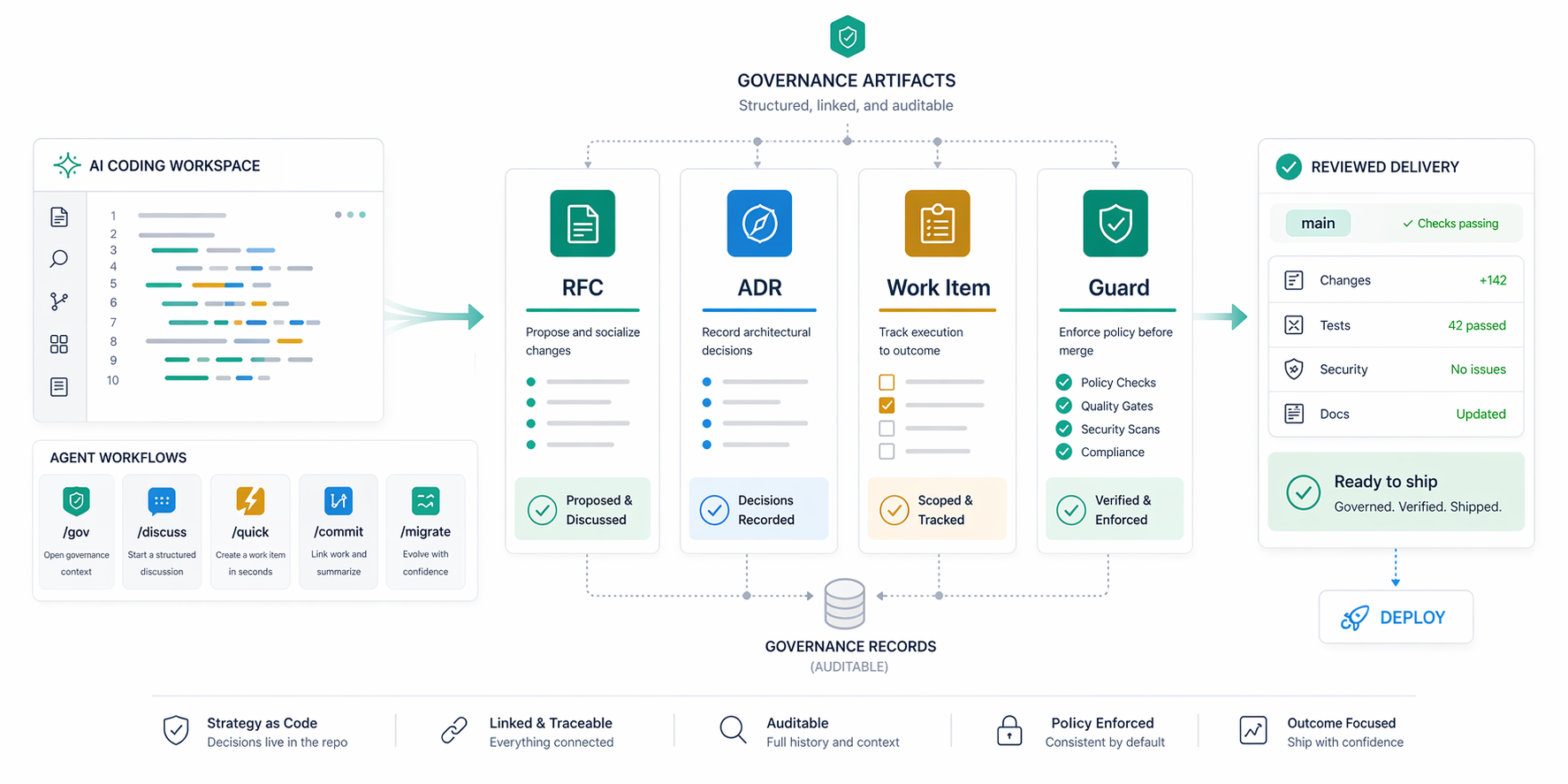
govctl is a governance-as-code CLI for teams using AI to build software seriously.
It gives AI-assisted development a control plane that lives in your repo:
- RFCs say what must be true
- ADRs record why a design was chosen
- Work items track execution and acceptance criteria
- Verification guards enforce executable completion gates
The point is not bureaucracy. The point is that AI-generated changes become reviewable, traceable, and phase-gated.
Why govctl
Most AI coding tools optimize for generation. govctl optimizes for delivery.
Without explicit governance, teams drift into the same pattern:
- ideas jump straight into implementation
- decisions live in chat history instead of artifacts
- code and specs diverge silently
- "done" means "the agent stopped typing", not "the work passed verification"
govctl closes that gap by making governed artifacts, lifecycle, and verification part of the normal workflow.
Without govctl:
  prompt -> code -> drift -> arguments

With govctl:
  RFC / ADR -> work item -> guarded implementation -> stable history
What Makes It Different
1. Spec-first by default
govctl is built around the idea that implementation follows governed artifacts.
In practice, that means:
- RFCs describe externally relevant behavior and constraints
- ADRs record design choices and trade-offs
- work items execute against those artifacts
- verification guards and lifecycle gates decide when work is actually done
Instead of treating prompts as the source of truth, the source of truth becomes governed artifacts in the repository.
2. Artifacts are the control plane
govctl does not hide governance behind a web app or an MCP server.
Artifacts live in gov/ as TOML files with schema headers, references, and stable CLI access. That means:
- changes are diffable
- decisions are reviewable in PRs
- agents can operate against files and commands you already understand
3. One CLI agents can reliably operate
The CLI is the operating surface for agents:
list,show,get,edit- resource-specific lifecycle verbs like
adr accept,rfc advance,rfc supersede, andwork move - path-first mutation through
edit - explicit help text designed to act as a reliable command contract
This matters because agent workflows get better when the interface is stable, local, and inspectable.
4. Works in brownfield repositories
This is not only for greenfield projects.