README.md1 min read










Make GPU Sharing Flexible and Easy
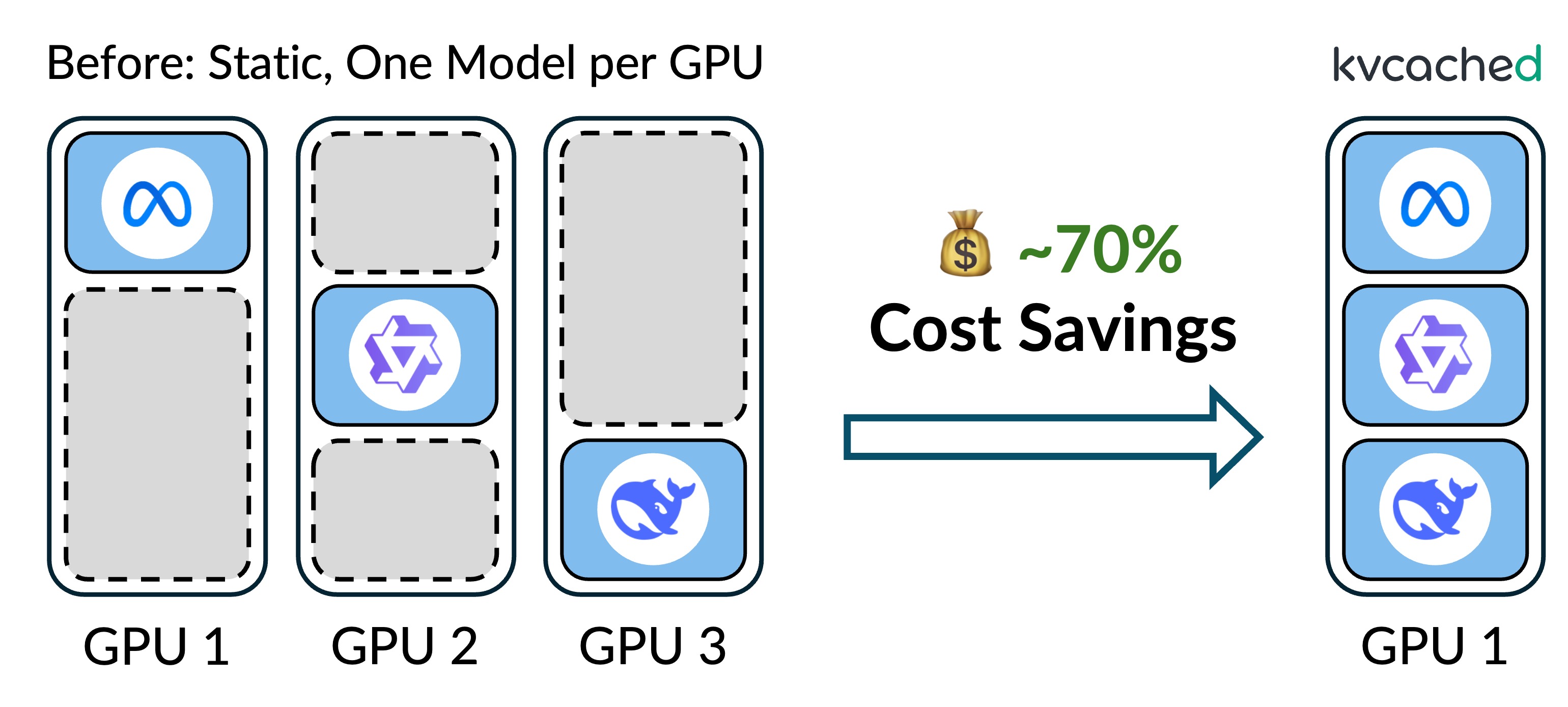
kvcached (KV cache daemon) is a KV cache library for LLM serving/training on shared GPUs. By bringing OS-style virtual memory abstraction to LLM systems, it enables elastic and demand-driven KV cache allocation, improving GPU utilization under dynamic workloads.
kvcached achieves this by decoupling GPU virtual addressing from physical memory allocation for KV caches. It allows serving engines to initially reserve virtual memory only and later back it with physical GPU memory when the cache is actively used. This decoupling enables on-demand allocation and flexible sharing, bringing better GPU memory utilization under dynamic and mixed workloads. Check out more details in the blog.
Key Features
- Elastic KV cache: allocate and reclaim KV memory dynamically to match live load.
- GPU virtual memory: decouple logical KV from physical GPU memory via runtime mapping.
- Memory control CLI: enforce memory limits with kvcached CLI.
- Frontend router and sleep mode: route requests to the target models and put models to sleep when idle.
- Support mainstream serving engines: integrate with SGLang and vLLM.
- Prefix caching: support automatic prefix caching (APC) with a configurable memory bound. See the example doc for details.
📢 Updates
- [2026-04] kvcached is featured by Red Hat for running LLMs dynamically in production under limited resources! Red Hat's Sardeenz builds on kvcached to provide dynamic multi-model serving with Kubernetes and OpenShift support. See the [blog post](https://www.redhat.com/en/blog/running-llms-dynamically-produc