README.md1 min read

OpenViking: The Context Database for AI Agents
Website · Live Demo · GitHub · Issues · Docs






👋 Join our Community
📱 Lark Group · WeChat · Discord · X
What is OpenViking
OpenViking is an open-source context database for AI agents. It stores memories, resources, and skills as one virtual filesystem under the viking:// protocol, so an agent browses its own context with ls, tree, and find instead of querying a black-box vector store. Content is processed into three tiers — L0 abstract, L1 overview, L2 details — and loaded on demand. Every retrieval leaves a trajectory you can watch and debug. Full introduction: Getting started.
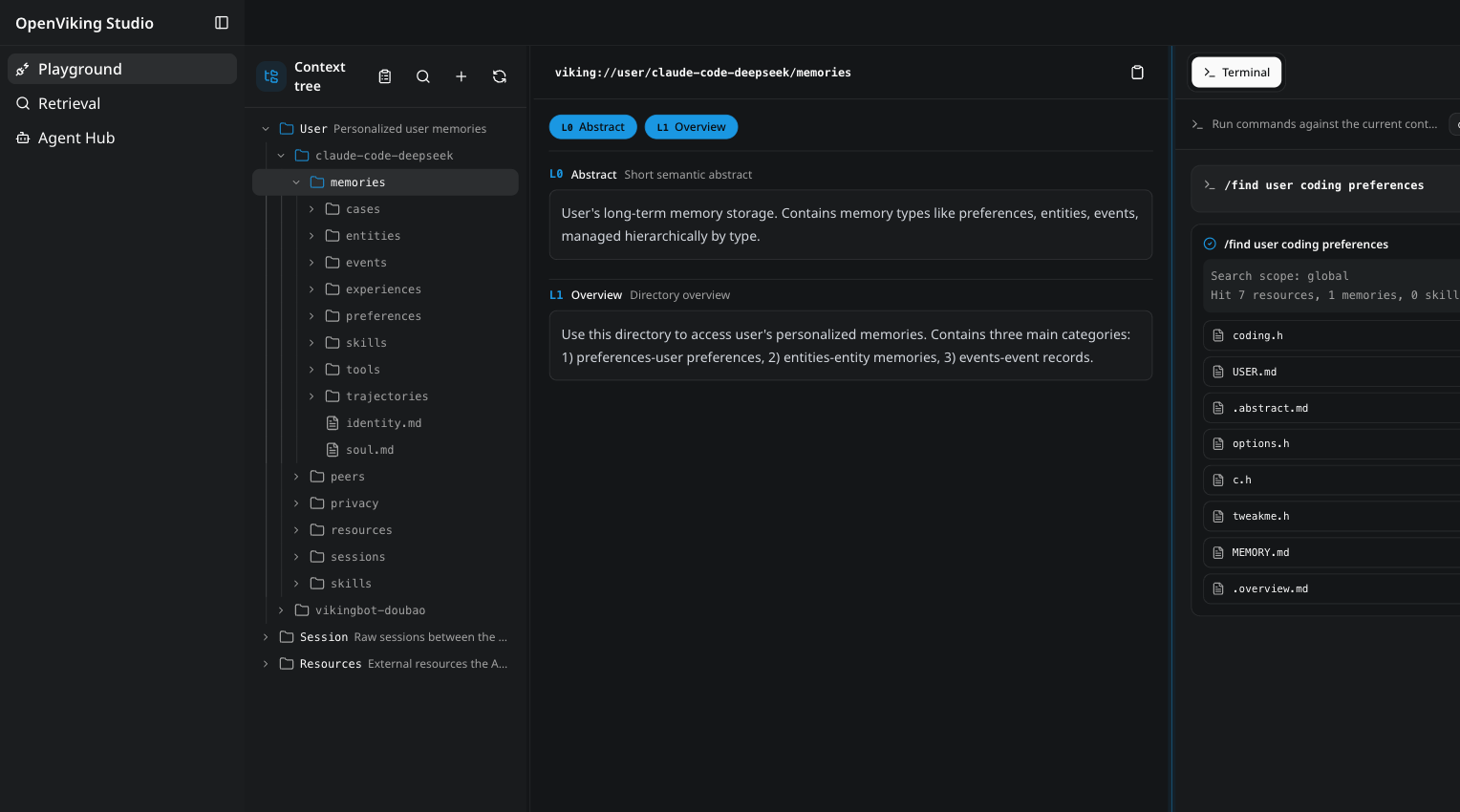
The OpenViking Studio playground — a live demo you can open in the browser, no installation required.
Why OpenViking
- One filesystem for all context. Memories, resources, and skills each get a
viking://URI. Agents locate and manipulate context deterministically, like a developer working with files. → Viking URI · Context types - Tiered loading cuts token spend. Every entry is processed into L0 (abstract), L1 (overview), and L2 (details) on write, then loaded only as deep as the task requires. → Context layers
- Directory recursive retrieval. Vector search first locates the highest-scoring directory, then drills down layer by layer, so results arrive with their surrounding context intact. → Retrieval
- Observable retrieval. Each query preserves its directory-browsing trajectory. When a result looks wrong, you can see exactly which path produced it. → [Retrieval](https://docs.openviking.ai/en/