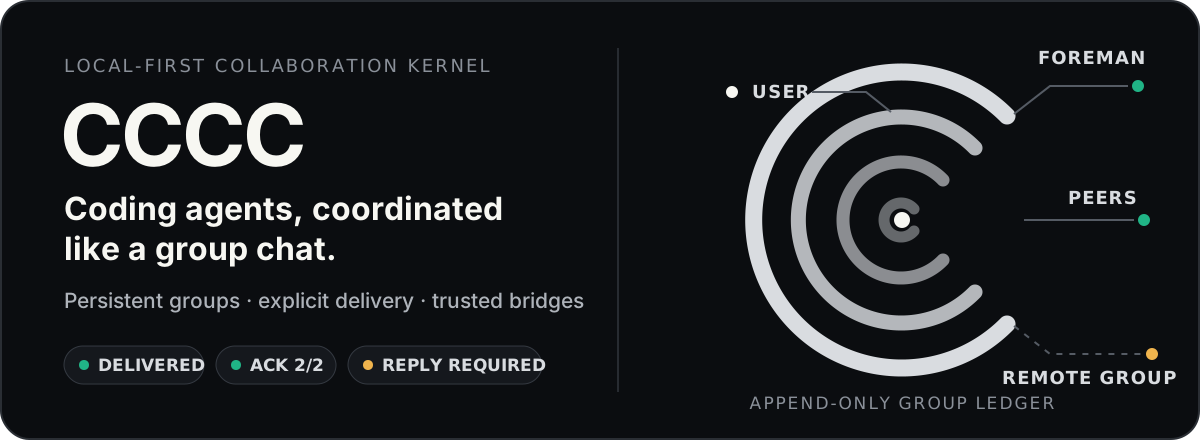
CCCC
Coordinate your coding agents like a group chat
Read receipts, delivery tracking, cross-instance collaboration, and mobile ops — for Claude Code, Codex, ChatGPT Web, and other supported runtimes in one durable group.
Run multiple coding agents as a persistent, coordinated team across runtimes, machines, and trusted working groups — not a pile of disconnected terminal sessions.
One install command. No Rust toolchain or infrastructure required.





Why CCCC
When several coding agents share work, you need to know who owns a task, whether a message reached its recipient, and what survives a restart. CCCC brings that coordination into one place, with Web and IM access when you are away from the terminal.
CCCC runs your agents as one durable, coordinated system:
- Durable coordination — message history lives in an append-only ledger; tasks and shared context have their own persistent stores.
- Visible delivery semantics — routing plus separate stored, runtime-delivery, read, and reply facts replace best-effort prompting.
- One control plane — Web UI, CLI, MCP, and IM bridges all operate on the same daemon-owned state.
- Multi-runtime by default — Claude Code, Codex CLI, ChatGPT Web, Grok Build, and other supported runtimes can collaborate in one group.
- CCCC Connect across instances — use same-account discovery, approved cross-member Group connections, or account-free Direct connections; each instance keeps its own state and access boundaries.
- Local-first operations — one install command, runtime state in
CCCC_HOME, and remote supervision only when you choose to expose it.
What CCCC Does
CCCC installs with one command and needs no separately operated database, message broker, or Docker:
| Capability | How |
|---|---|
| Durable event history | Append-only ledger (ledger.jsonl) records messages and collaboration events for replay and audit |
| Reliable messaging | Send / Send + Reply / Mail, separate delivery/read/reply facts, and a Mail-only Inbox consumed in ledger order — runtime handoff never pretends a message was read |
| Unified control plane | Web UI, CLI, MCP tools, and IM bridges all talk to one daemon — no state fragmentation |
| Multi-runtime orchestration | Mix supported coding-agent runtimes in one Group, with custom for other command-line agents |
| CCCC Connect | Connect your own instances, selected Groups across member accounts, or two Groups directly without an account |
| Workspace tools | Browse and edit files, inspect Git changes, pin documents in Presentation, and operate tiled native terminals |
| Voice workflows | Voice Secretary turns speech into documents or composer drafts; experimental Codex Voice pairs realtime conversation with a Runtime-backed Analyst |
| Role-based coordination | Foreman + peer model with permission boundaries |