




SLayer
An expressive, embeddable semantic layer for AI agents and humans.
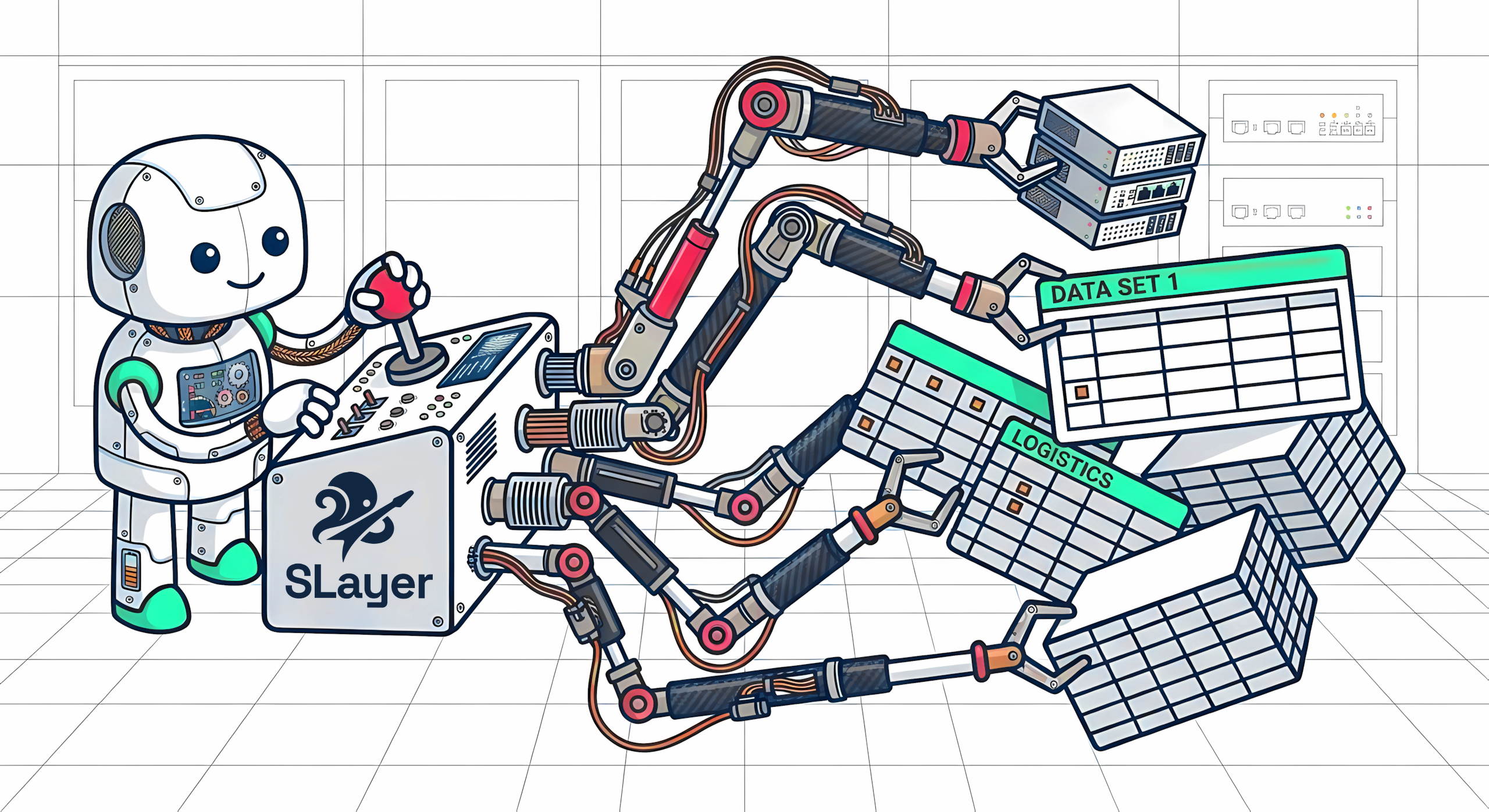
SLayer enables AI-powered data analytics on top of your warehouse. Agents get a governed, shared surface through which they access your data and metrics and give you reliable answers.
SLayer handles database connectivity (read-only), SQL translation, common data transformations, and row-level security, so LLMs and humans don't have to. Adapt it to your workflows, not the other way around. Manage definitions easily with an agent or by yourself.
SLayer can be used as a standalone tool or imported as a Python library, easily embeddable into any Python app. Use it for powering analytical MCP servers or APIs or simply to query databases semantically.
SLayer is at the core of Motley and is maintained with ♡ by the same team.
How SLayer is different
Traditionally, semantic layers were a part of the BI stack, where every metric and its aggregation had to be predefined. Agents need more flexibility because users ask questions that involve metric combinations (like ratios), transforms (like time shifts), or different aggregations of the same metric (like average instead of sum).
SLayer allows to define a column revenue once and query it using expressions like sum(revenue), avg(revenue), sum(revenue) / count(*), time_shift(sum(revenue), -1, 'year') etc.; multi-stage queries are also supported.
SLayer is focused on the common agentic search → inspect → query flow. It has a search tool for efficient discovery and a memory store for linking the relevant business context.
Agents, apps and humans can talk to SLayer via MCP, REST API, CLI, Python, Flight SQL, or Postgres-based SQL API. SLayer supports most popular databases.
SLayer fits next to your existing data stack. It also provides importers for dbt, Cube, and Ossie configs.
See docs for more.
Example
Question (run on the built-in demo Jaffle Shop database): "show monthly revenue by store, with month-over-month % change"
Side by side, here's LLM-generated SQL and the equivalent SLayer query.
Quickstart
We recommend using uv, especially if you don't work in a Python project.
u