CodeFlow
Visualize Your Codebase Architecture in Seconds
Zero setup. No installation. Just paste a GitHub URL.


Try it Now · Report Bug · Request Feature
Why CodeFlow?
Ever opened a new codebase and felt completely lost? CodeFlow turns any GitHub repository or local codebase into an interactive architecture map in seconds.
- No installation required — runs entirely in your browser
- No data collection — your code never leaves your machine
- No accounts — just paste a URL or select local files and go
- Works offline — analyze local files without internet
Paste URL / Select Files -> See Architecture -> Make Better Decisions
Features
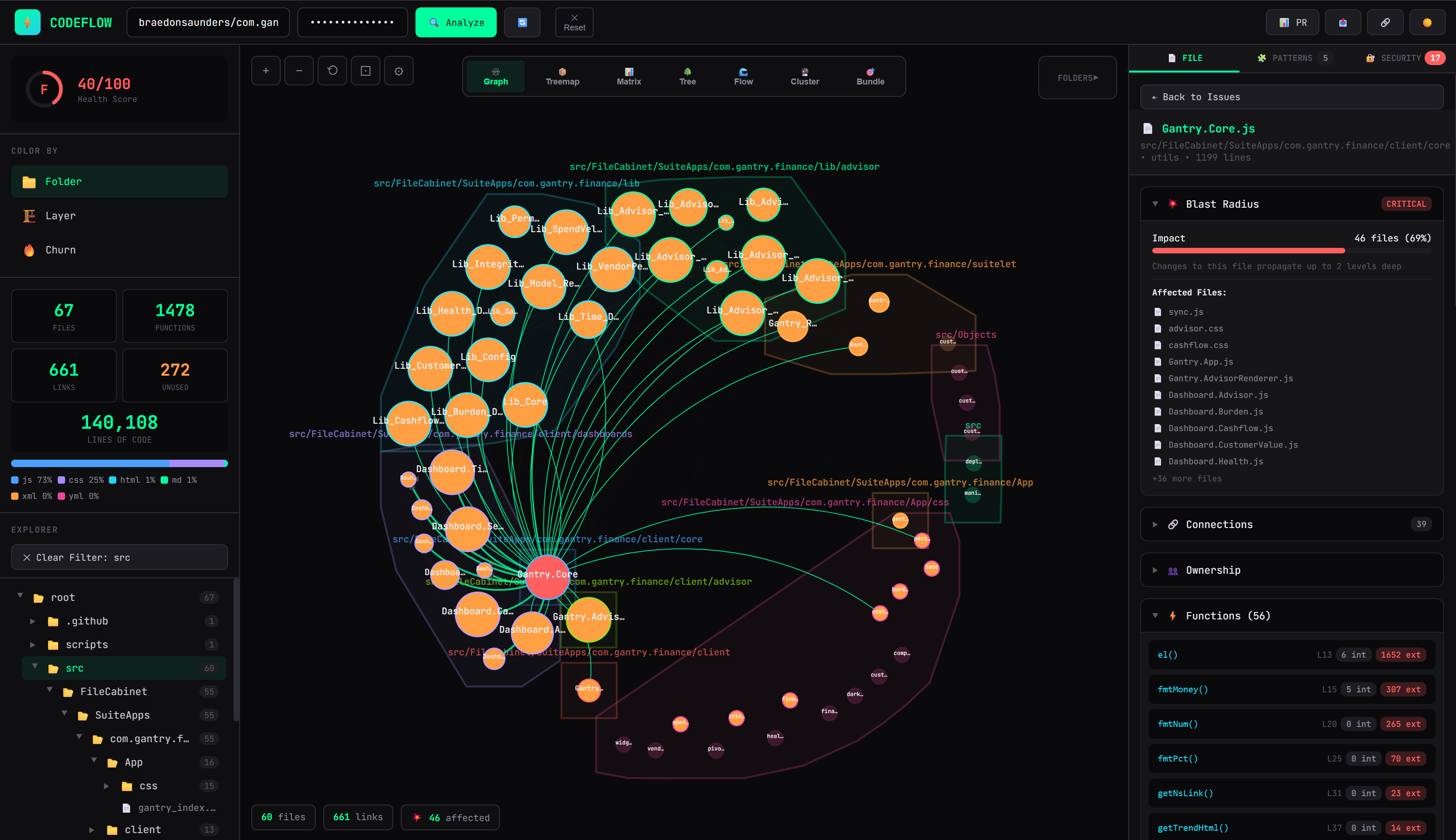
Interactive Dependency Graph
See how your files connect at a glance. Click any node to highlight its dependencies. Drag, zoom, and explore.
Blast Radius Analysis
"If I change this file, what breaks?" — CodeFlow answers this instantly. Select any file and see exactly how many files would be affected by changes.
Code Ownership
Know who owns what. See the top contributors for any file based on git history. Perfect for code reviews and knowing who to ask.
Security Scanner
Automatic detection of:
- Hardcoded secrets & API keys
- SQL injection vulnerabilities
- Dangerous
eval()usage - Debug statements in production code
Test files, fixtures, docs/, and common tooling directories (.github/, .claude/, scripts/) are excluded from the XSS/shell-execution checks, since findings there don't reflect the shipped product's attack surface. The hardcoded-secret check exempts only tests, fixtures, and docs: CI workflows, hooks, and deploy scripts are executable code, so a real credential there is still a real leak.
Pattern Detection
Automatically identifies:
- Singleton patterns
- Factory patterns
- Observer/Event patterns
- React custom hooks
- Anti-patterns (God Objects, high coupling)
Health Score
Get an instant A-F grade for your codebase based on:
- Dead code percentage
- Circular dependencies
- Coupling metrics
- Security issues
Activity Heatmap
Color files by commit frequency to see which parts of your codebase are most actively developed.
PR Impact Analysis
Paste a PR URL to see exactly which files it affects and calculate the blast radius of proposed changes.
CodeFlow Card (GitHub Action)
Health grade, scale, fragility, and hidden costs as a self-updating SVG on your README — recomputed every merge, with optional thermal-receipt PR comments. See card/.
Markdown & Wiki-Link Graph
Point CodeFlow at an Obsidian vault or any markdown directory to see notes as a connected graph. Both [[wiki-links]] and [text](./relative.md) links become edges; each note is a note-layer node (distinct color) with a dependencies[] array in the JSON export.
Local File Analysis
Analyze code directly from your computer without uploading to GitHub:
- Privacy First: Your code never leaves your machine
- Offline Support: Works without internet connection
- Drag & Drop: Simply drag files or folders to analyze
- Folder Scanning: Recursively analyze entire project structures
- Exclude Patterns: Skip attachments, caches, generated assets, and other irrelevant paths before scanning
- Instant Results: All processing happens in your browser
CodeFlow Card
A GitHub Action that drops an auto-updating SVG card on your README, recomputed on every merge by the same analyzer as the web app. Five styles, accent presets, o