
Deep memory for agents over large datasets.
Index any table, export or log once; your agent gets the few records that answer the question.


Leviathan is a single binary that turns records (JSONL, JSON, CSV/TSV, SQLite, or any database CLI's output) into a ranked full-text index. Agents ask in plain words and get short, cited result cards: ~450 tokens per answer at any dataset size, instead of grepping and reading raw history.
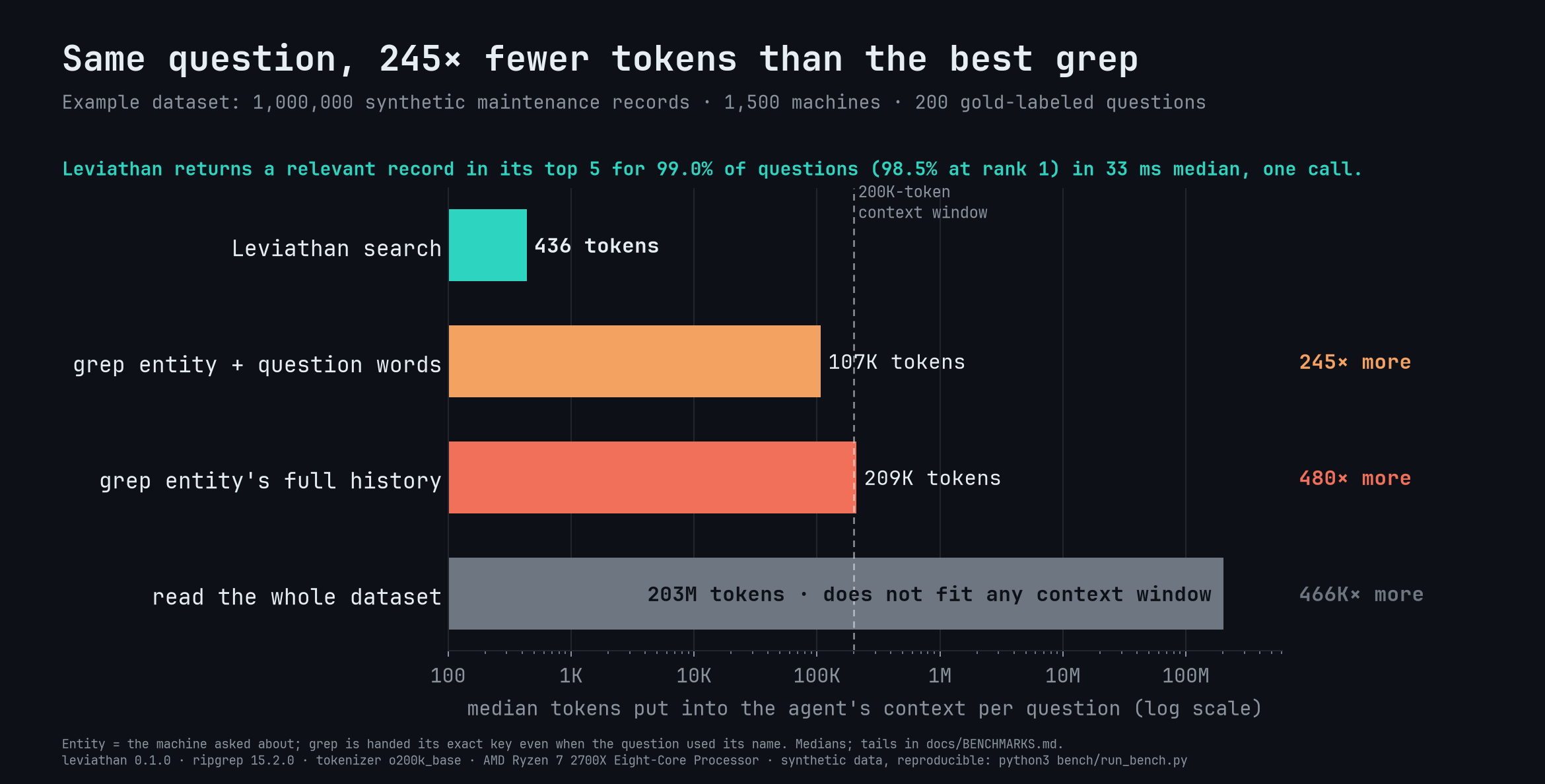
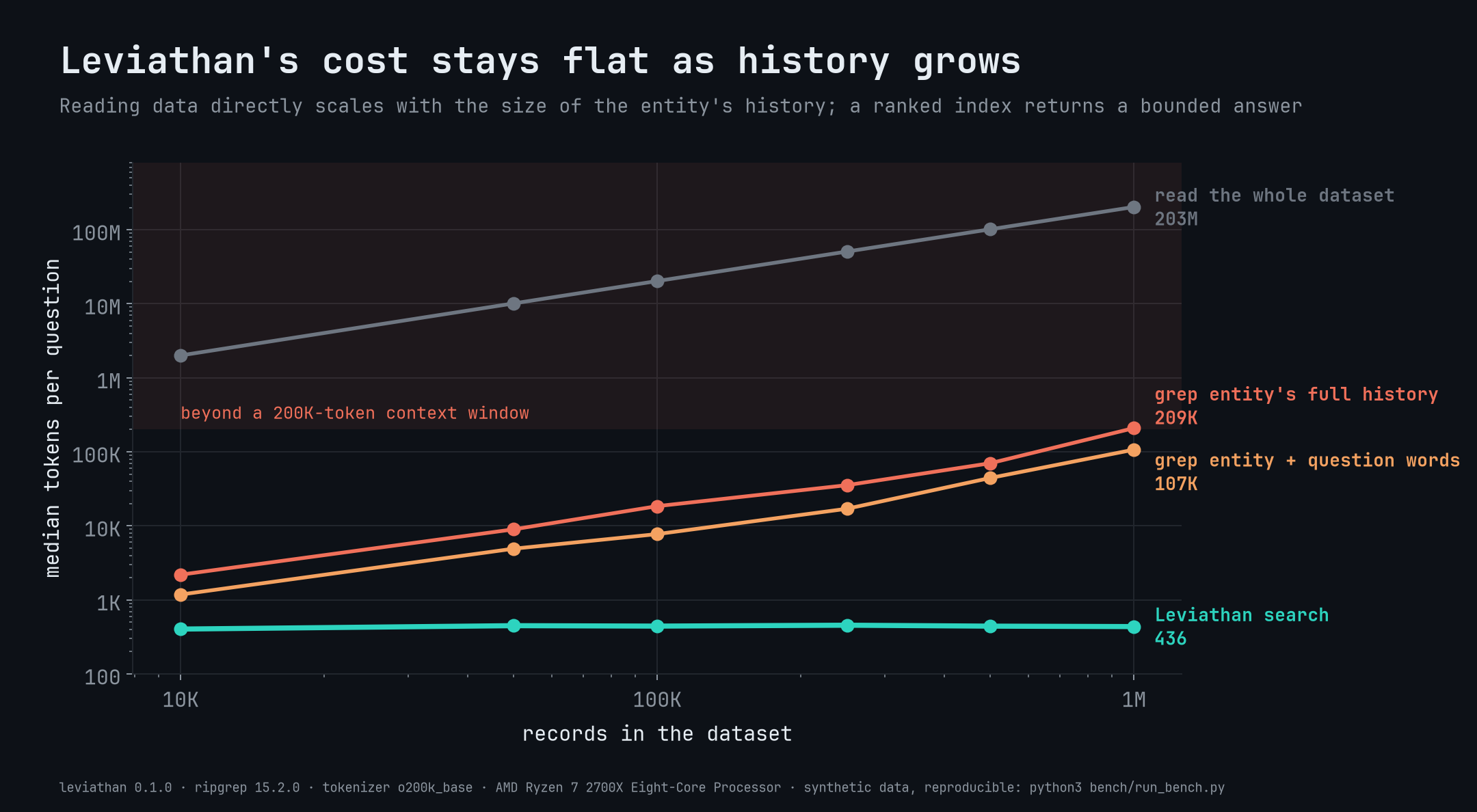
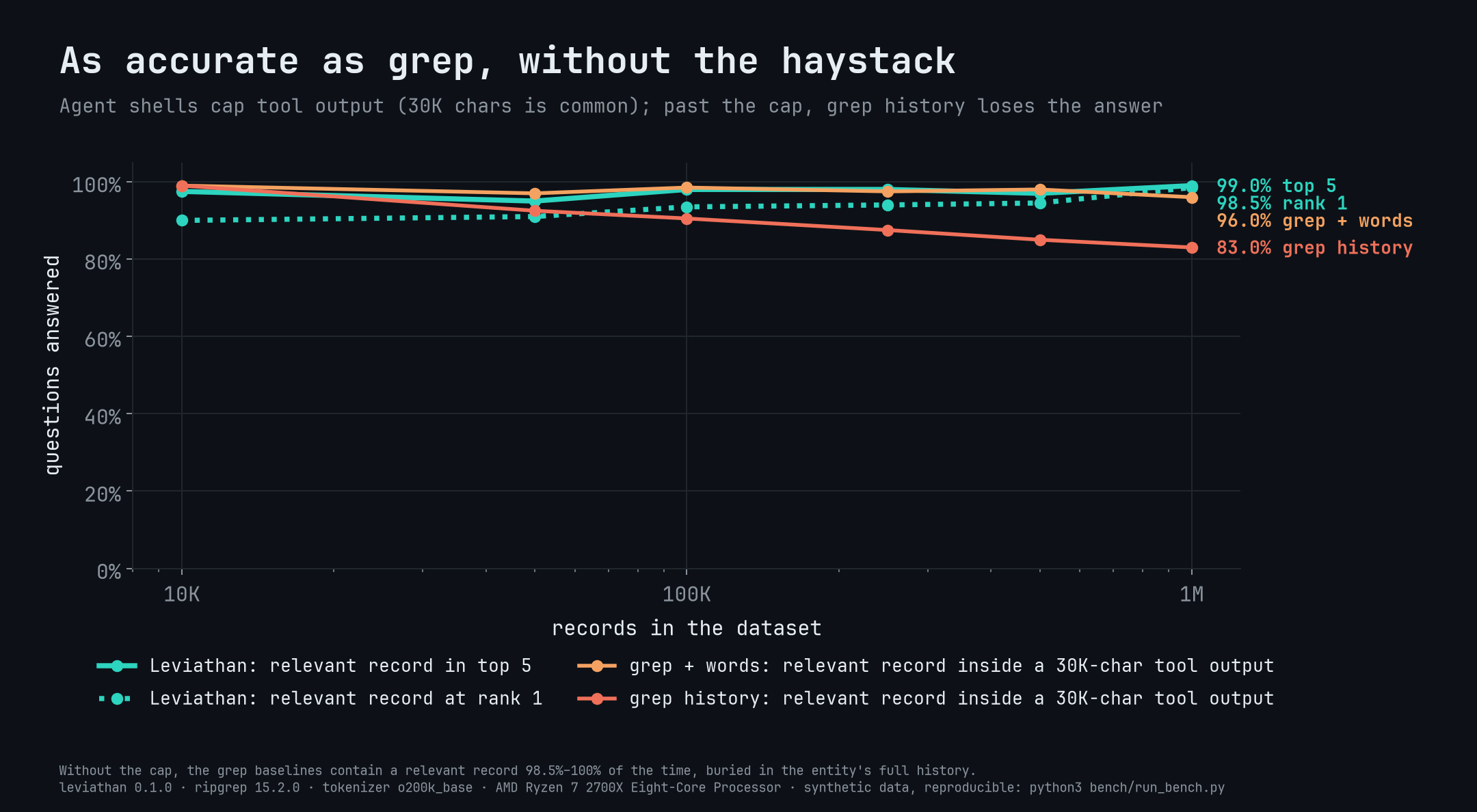
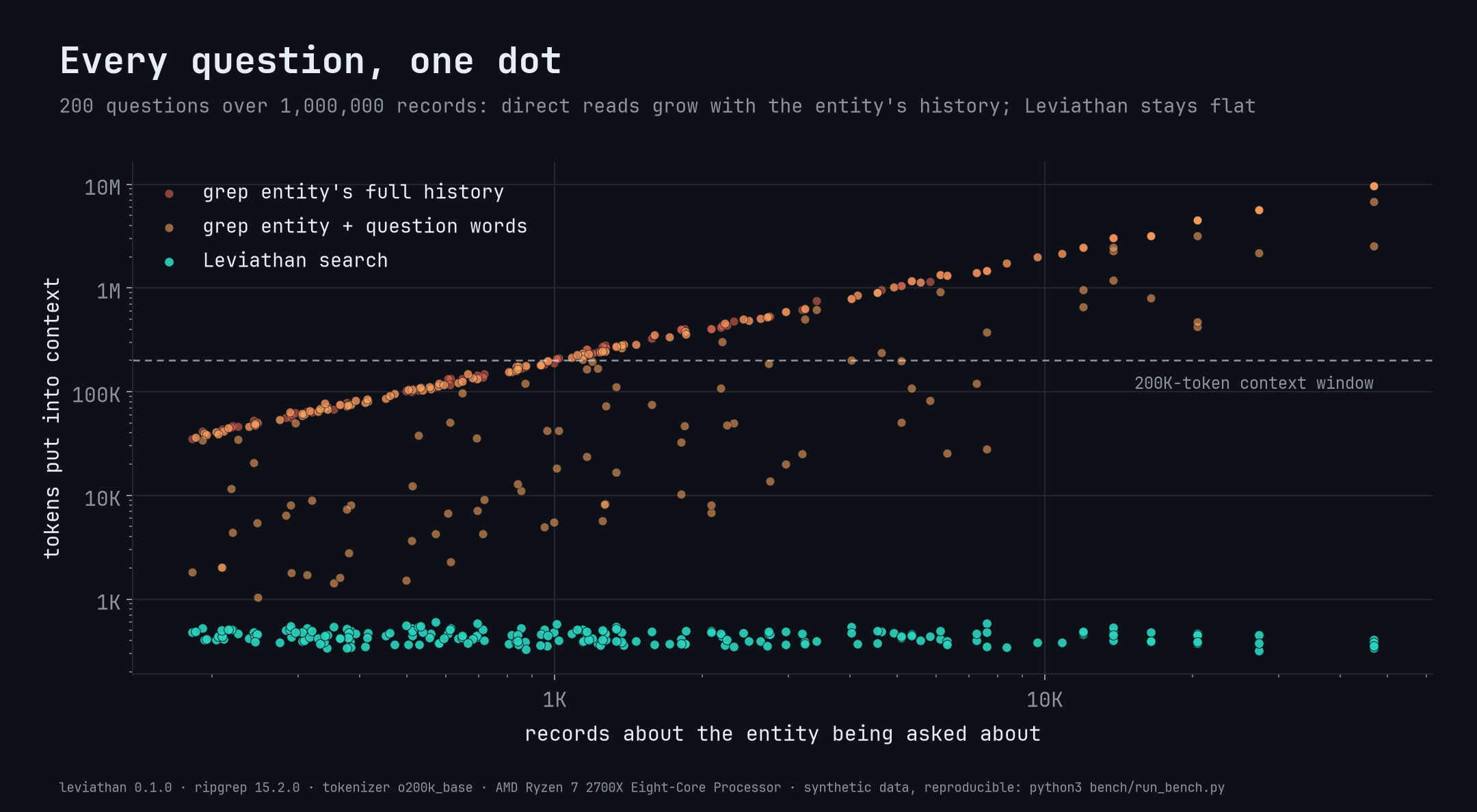
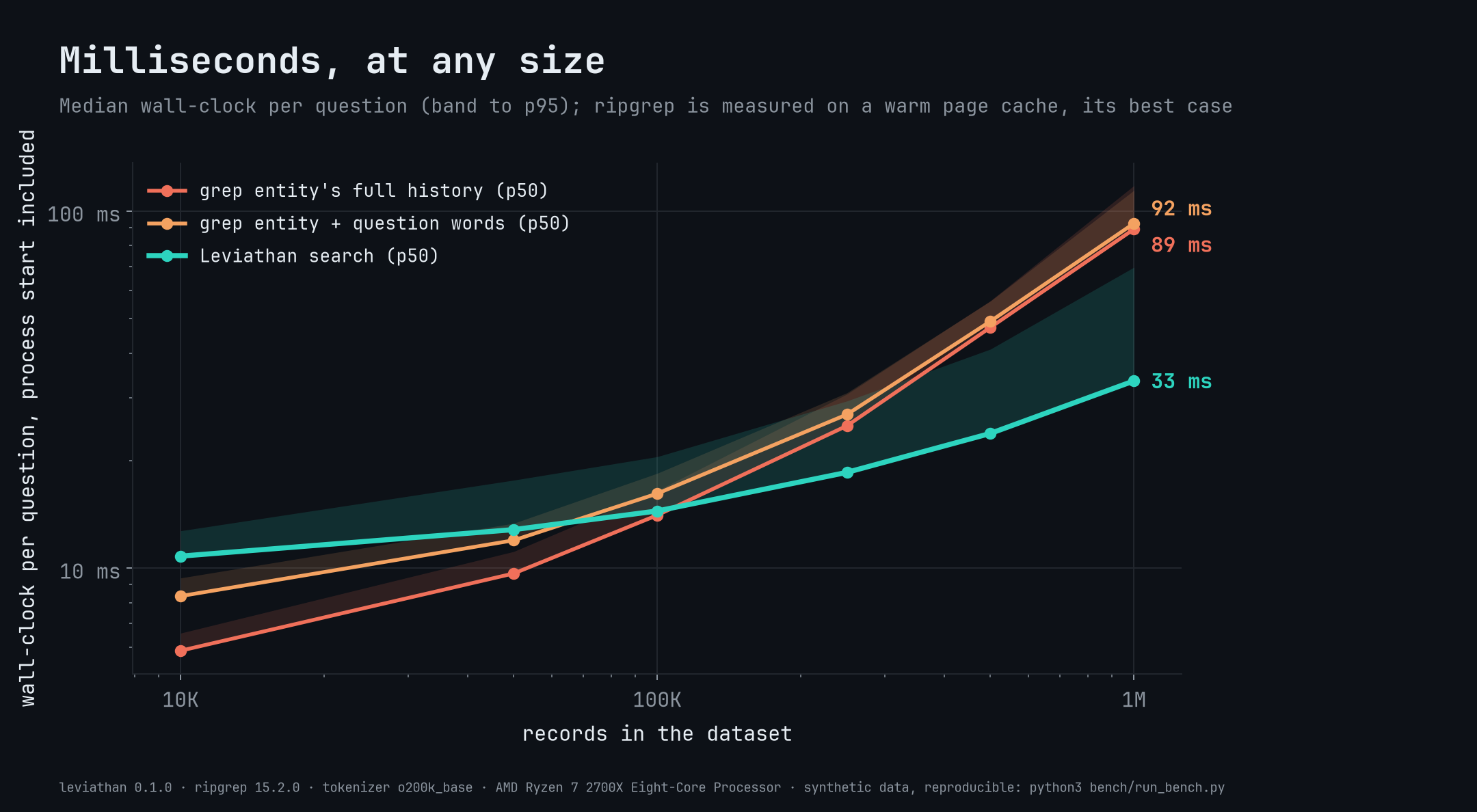
| At 1M records (678 MB) | Leviathan | best grep strategy |
|---|---|---|
| Median tokens per question | 436 | 107,122 (245×) |
| Relevant record returned | 99.0% top 5 · 98.5% rank 1 | 96.0% within a 30K-char output |
| Worst case (1,200 questions) | 602 tokens | 9.7M tokens |
| Median latency | 33 ms | 92 ms |
Measured on a synthetic maintenance log (one example dataset; nothing in Leviathan is specific to it). Methodology, all six scales and caveats: docs/BENCHMARKS.md.
Quickstart
cargo install leviathan-index       # or: cargo install --git https://github.com/elstongun/leviathan
cd examples/tickets && leviathan index
leviathan search -g acme "sso login loop after password reset"
leviathan search · customer C-ACME "Acme Corp" (7 tickets) · query "sso login loop after password reset" · shown 3 of 3 · 24 tickets indexed
[1] T-1001 · 2024-01-08 09:12 · rel 16.9
  Login loops back to sign-in page after password reset
  status: closed · priority: high
  resolution: Cleared stale session cookies on password reset; shipped in 4.2.1. Workaround: clear site data.
  match: Users who reset their password get redirected to the sign-in page again in an endless loop.
...
-gaccepts a key, name or partial name. Ambiguous or unknown groups list candidates and exit 3, never guess.- No match in the group falls back to other groups, labeled
OTHER CUSTOMER. - Combine
--where field=value,--since/--until,"phrases"and-exclusions.
Prebuilt binaries are on Releases. No runtime dependencies; the index is one SQLite file.
Map your data
Fields are paths (a.b, items[].name); only id is required.
| Field | Enables |
|---|---|
id |
get, upsert, delete, citations |
title / text |
Card headline (weighted 2×) / searched text (default: all strings) |
group / group_name |
-g scoped search, name resolution, labeled fallback |
date |
--since, --until, recent |
filters / display |
--where facets / fields shown on cards |
empty_values / rank.boost |
Placeholders treated as missing / favor complete records |
leviathan index ./export # everything in a fol