evo




Get started with autoresearch on any codebase - with two simple commands.
Do you want to do more with autoresearch or need a custom, hands-on deployment? Request access to evo platform or email hello@evo-hq.com.
Try it · Install · How it works · Dashboard · Upgrading
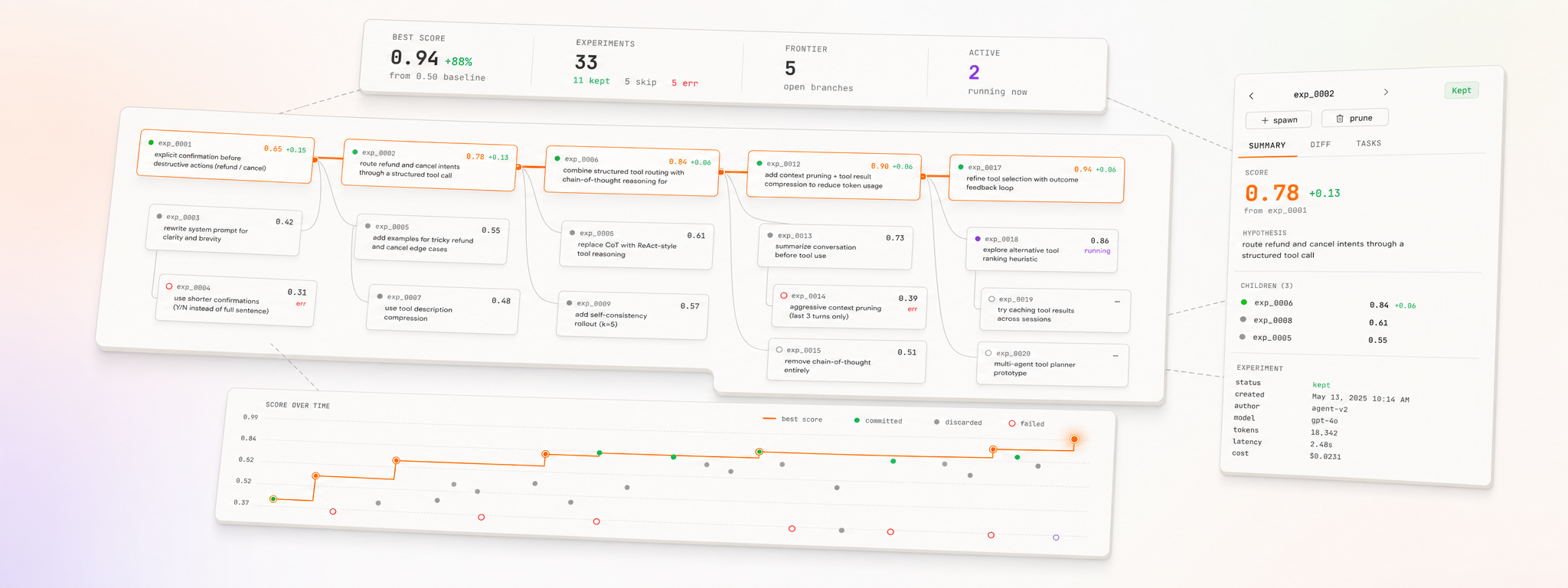
You give it a codebase. It discovers metrics to optimize, sets up the evaluation, and starts running experiments in a loop -- trying things, keeping what improves the score, throwing away what doesn't.
Inspired by Karpathy's autoresearch -- where an LLM runs training experiments autonomously to beat its own best score. Autoresearch is a pure hill climb: try something, keep or revert, repeat on a single branch. Evo adds structure on top of that idea:
- Tree search over greedy hill climb. Multiple directions can fork from any committed node, so exploration doesn't collapse to one path.
- Parallel semi-autonomous agents. Spawn multiple subagents and run them simultaneously, each in its own git worktree. Each subagent reads traces, formulates hypotheses, and can run multiple iterations within its branch.
- Shared state. Failure traces, annotations, and discarded hypotheses are accessible to every agent before it decides what to try next.
- Gating. Regression tests or safety checks can be wired up as a gate. Experiments that don't pass get discarded.
- Observability. A dashboard to monitor your experiments.
- Benchmark discovery. The
discoverskill explores the repo, figures out what to measure, and instruments the evaluation.
Runs on Claude Code, Codex, Cursor, Kimi, OpenClaw, Hermes, Opencode, or Pi. Experiments run locally or on remote sandboxes — Modal, E2B, Daytona, AWS, Azure, SSH.
Try it
Two commands:
/evo:discover     # one-time code discovery: figures out benchmarks and creates gates against unintended changes
/evo:optimize     # run the loop
discover asks what to optimize, the benchmark command, and the metric direction. Skip the questions by seeding the answer:
/evo:discover make the JSON parser at src/parser.py faster
Then run the loop:
/evo:optimize
evo sizes each round to your benchmark's resource profile — one experiment at a time when a run needs the whole GPU or another exclusive resource, wider when runs are independent — and keeps going until the score stops improving. By default it runs unattended and pushes edits through parallel subagents; say so in plain language if you'd rather it pause after each round or hold to one experiment at a time.
Invocation syntax is host-specific: /evo: on Claude Code, $evo on Codex, / skill menu on Cursor, natural language on Hermes, Opencode, OpenClaw, and Pi.
Install
# 1. evo CLI
uv tool install evo-hq-cli

# 2. Host CLI (if you don't already have it)
npm install -g @anthropic-ai/claude-code     # or @openai/codex, openclaw, @earendil-works/pi-coding-agent
# Cursor: install from cursor.com (IDE), or `curl https://cursor.com/install -fsS | bash` for the cursor-agent CLI
# Kimi: `curl -fsSL https://co