fractal




Hierarchical agent loops with recursive self-organization.
In a fractal, autonomous agent loops arrange themselves into a tree: a node
iterates toward a goal in its own git worktree and spawns child nodes for
separable subtasks, so the tree grows to fit the problem rather than a fixed
plan. Hard caps (iterations, depth, children, cost, time) keep each loop
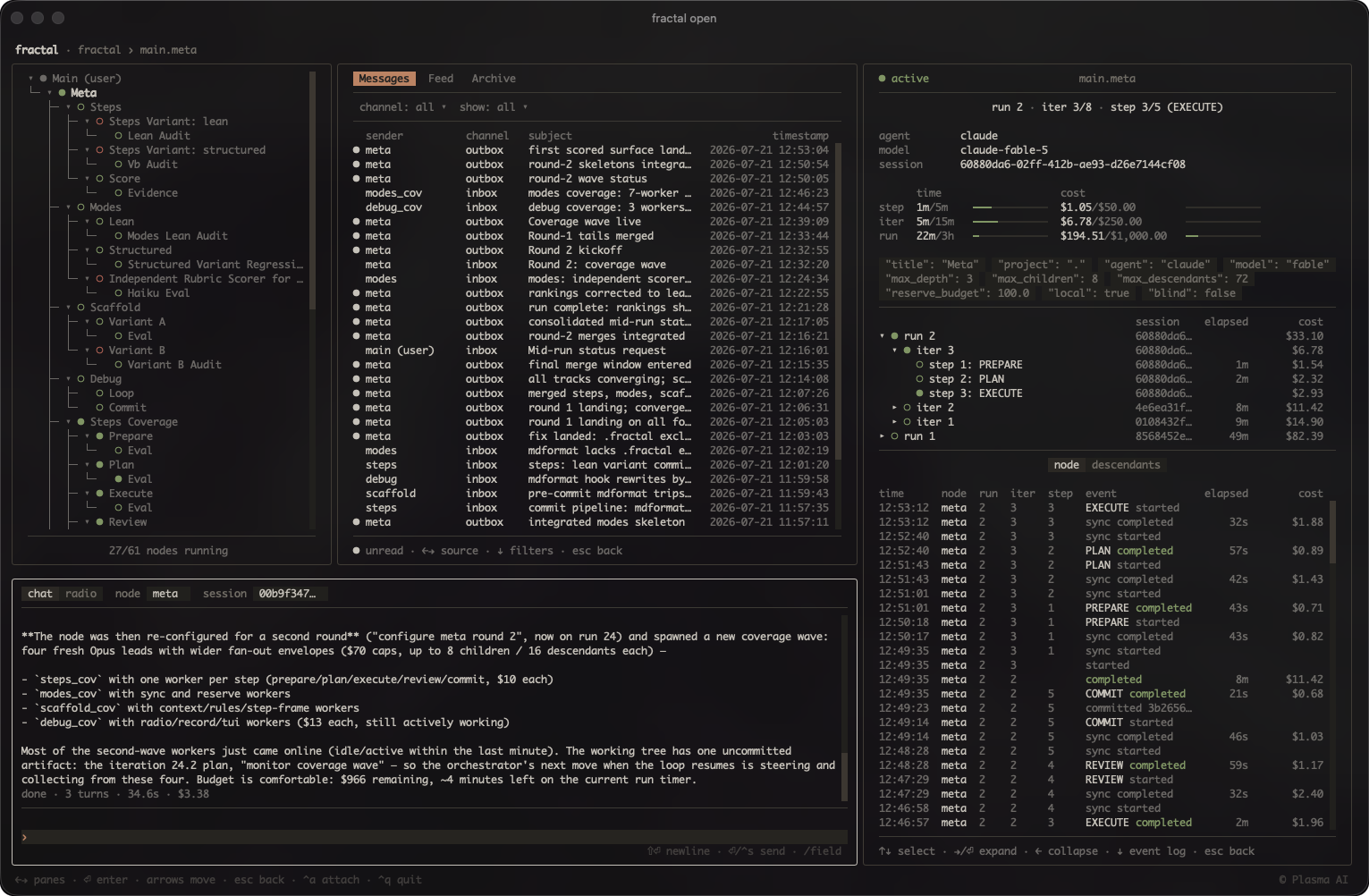
bounded, and an operator can steer or stop it at any point. Run metadata
(including cost) lands in one local SQLite database, which can be interacted
with live in a terminal UI.
[!WARNING] Nodes run their agent without permission prompts by default. Unattended loops cannot stop to ask, so every seeded agent config disables the approval gate — Claude
bypassPermissions, Codexdanger-full-access, Grok--always-approve, opencode--auto, omp--yolo. A node can therefore run any command its agent decides to run, with your credentials and your machine's reach. The per-nodegit worktreeisolates the branch it commits to, not the filesystem, the network, or anything else outside it. Only launch nodes whose task you would trust to run unsupervised, and prefer a sandboxed or otherwise disposable host for anything else.
Source: https://github.com/plasma-ai/fractal
Package: https://pypi.org/project/plasma-fractal/
Documentation: https://docs.plasma.ai/fractal
Installation
Install the fractal package from PyPI:
pip install plasma-fractal
or
pip install fractal
Use pipx install or uv tool install to install the package in an isolated
environment. If you use one of these two methods, you must also install
plasma-wiki (a plain pip install pulls plasma-wiki and puts wiki on your
PATH, but this is not the case when using pipx install or
uv tool install).
uv tool install plasma-fractal --with-executables-from plasma-wiki does the
same in one command.
Open the dashboard from your project root with fractal open (requires an
initialized fractal). Pass --light if your terminal uses a light color scheme.
Skill
Install the skill for your agent via the plugin marketplace (Claude Code and Codex):
# Claude Code
/plugin marketplace add plasma-ai/plugins
/plugin install fractal@plasma

# Codex
codex plugin marketplace add plasma-ai/plugins
codex plugin add fractal@plasma
Another install route is from the CLI, which copies (or symlinks) the fractal
and wiki skills into ~/.claude/skills and ~/.agents/skills (add --project
for the current project only):
fractal install [