Metronix Memory
Self-hosted memory infra for AI agents — MCP-native, local-model friendly: hybrid RAG + temporal knowledge graph & ontology layer, durable memory, freshness checks, agent-scoped context.
Metronix gives agents a memory backend they can actually call: ingest files and SaaS knowledge, retrieve with dense + sparse + graph context, store durable facts and preferences per agent, and keep long-lived knowledge fresh as projects change.
What You Get
- Durable memory for every agent — store facts, preferences, and pinned context with workspace and agent scoping.
- A knowledge backend your agents can use — ingest files and connected SaaS sources, then retrieve hybrid dense, sparse, and graph context with source citations.
- Control over your data and models — run the full stack yourself with Docker, bundled local models, and optional external answer generation.
- One integration point for your tools — connect MCP-native agents now, or use the REST API and native Hermes memory provider where they fit best.
Quick Start
Start the local Docker stack, confirm that it is live, then connect your agent:
git clone https://github.com/mtrnix/metronix-memory.git
cd metronix-memory
cp .env.example .env
printf '\nMETRONIX_MCP_API_KEY=%s\n' "$(openssl rand -hex 32)" >> .env
docker compose up -d --build
curl http://localhost:8000/health
# {"status":"ok"}
Then follow Connecting To An Agent to give your MCP client durable memory. For the release installer, configuration, and troubleshooting, continue to Install.
Install | Runtime Guides | Benchmarks | Docs
Why Not Just...
| Option | What it gives you | What Metronix adds |
|---|---|---|
| Vector DB | Similarity search over embedded chunks | Ingestion, MCP tools, durable agent memory, sparse retrieval, graph context, and operational APIs |
| Long context | More tokens in one prompt | Persistent memory across sessions, agent/workspace scoping, retrieval, and freshness checks |
| Chat history | Transcript recall | Structured facts, preferences, pinned memory, temporal knowledge, and reusable context for any MCP-native agent |
Benchmarks
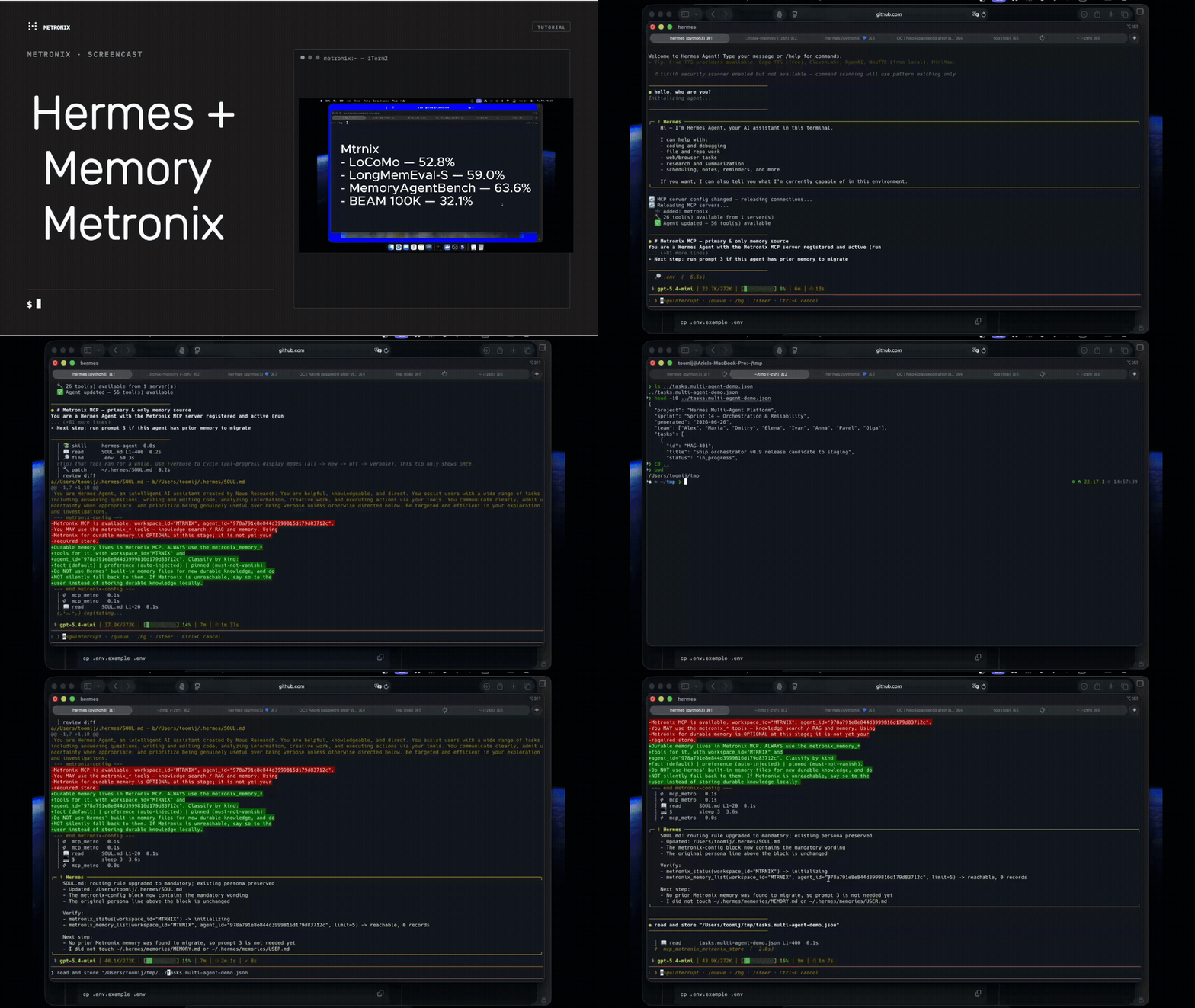
Directional N=1 results under benchmark-protocol v1.0: same answer model (deepseek-v4-flash, T=0), same blind judge (deepseek-v4-pro), same volume, and both retrieval + end-to-end layers.
| Benchmark | Scope | Layer B result | Retrieval / signal |
|---|---|---|---|
| LoCoMo | 1,982 / 1,982 QA pairs | 52.8% | Recall@10 85.3% |
| LongMemEval-S | 500 / 500 questions | 59.0% | Recall@10 95.4%; reproducible harness in benchmarks/longmemeval |
| MemoryAgentBench | 2,800 / 2,800 tasks | 63.6% | Accurate Retrieval 84.7%; EventQA blended 86.8% |
| EventQA | MAB EventQA 65K + 131K | 86.8% blended | 98.0% at 65K; 94.8% at 131K |
| BEAM 100K | 400 / 400 questions | 32.1% | Recall@10 2.9%; Layer B is the meaningful figure for this tier |
Metronix leads the equal-conditions comparison on LoCoMo and MemoryAgentBench, while Mem0 leads narrowly on LongMemEval-S and BEAM 100K. The recurring pattern is retrieval ahead of generation: relevant evidence is usually found, but answer synthesis, conflict resolution, and preference following remain the hard parts.
Integrations
| Agent/runtime | Path |
|---|---|
| Hermes | Native memory provider · MCP guide |
| Cursor | Cursor guide |
| Claude Desktop | [Claude Desktop guide](docs/integrations/claude-des |