Neo4j Agent Memory
A graph-native memory system for AI agents. Store conversations, build knowledge graphs, and let your agents learn from their own reasoning -- all backed by Neo4j.









What It Does
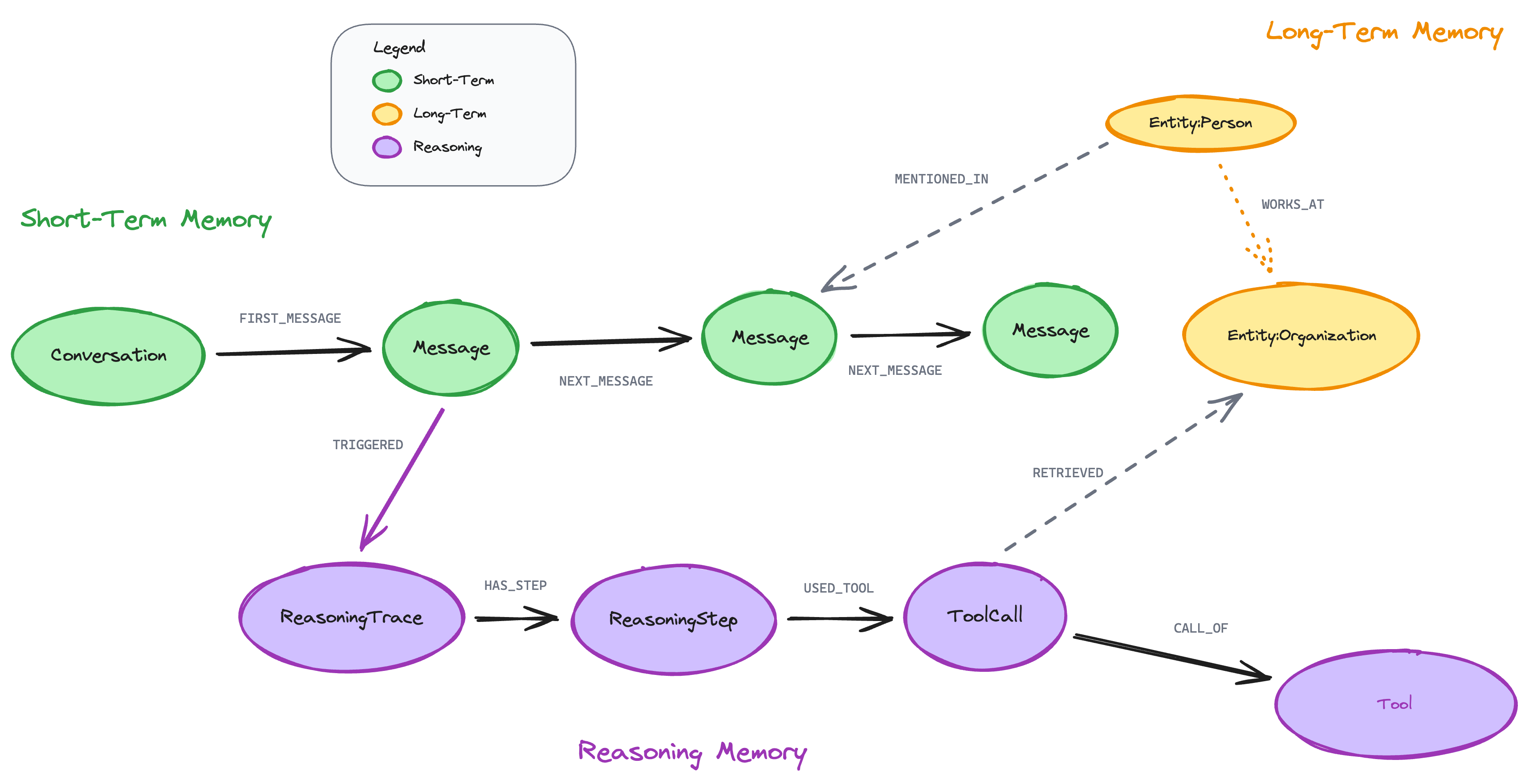
| Short-Term Memory | Long-Term Memory | Reasoning Memory |
|---|---|---|
| Conversations & messages | Entities, preferences, facts | Reasoning traces & tool usage |
| Per-session history | Knowledge graph (POLE+O model) | Learn from past decisions |
| Vector + text search | Entity resolution & dedup | Similar task retrieval |
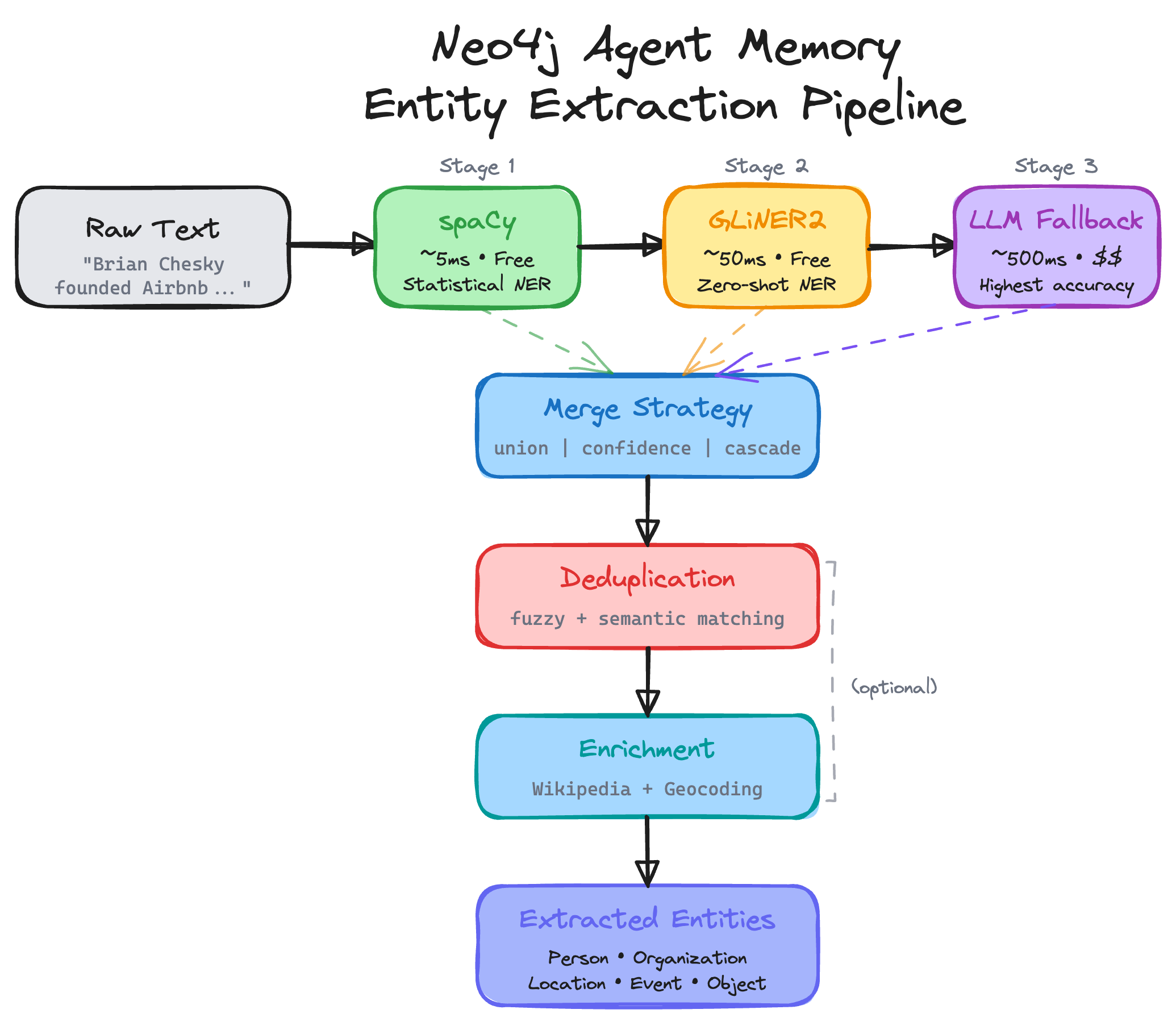
Plus: multi-stage entity extraction (spaCy / GLiNER / LLM), relationship extraction (GLiREL), background enrichment (Wikipedia / Diffbot), geospatial queries, MCP server with 16 tools, and integrations with LangChain, Pydantic AI, Google ADK, Strands, CrewAI, and more.
Production features: adopt an existing Neo4j graph as long-term memory (client.schema.adopt_existing_graph(...)), multi-tenant scoping (user_identifier=), fire-and-forget buffered writes (client.buffered.submit(...)), consolidation primitives (client.consolidation.dedupe_entities(...)), an eval harness (client.eval.run(suite)), and explicit :TOUCHED audit edges from reasoning steps to entities.
Bring your own model: MemorySettings.embedding and MemorySettings.llm accept a provider-string shorthand ("anthropic/claude-3-5-sonnet-latest", "BAAI/bge-small-en-v1.5") or a Provider instance. Native adapters for OpenAI, Anthropic, Bedrock, Vertex AI, and sentence-transformers; LiteLLM universal fallback covers 100+ providers (Cohere, Voyage, Groq, Together, Mistral, Ollama, ...). See the provider migration guide. (These configure the self-hosted backend; on NAMS, embedding and extraction run server-side.)
SDKs
neo4j-labs/agent-memory ships two SDKs with the same memory model, both
backed by the NAMS
hosted service. Pick the one that matches your stack — mixed Python +
TypeScript agents read and write the same memory.
| Language | Package | Install | Docs |
|---|---|---|---|
| Python | neo4j-agent-memory |
pip install neo4j-agent-memory |
Python SDK docs |
| TypeScript | @neo4j-labs/agent-memory |
`npm install @neo4j-labs/agent-memor |