
Run Mixture-of-Experts models bigger than your device's RAM. On a phone, on a PC, CPU only.



A Mixture-of-Experts model is made of many small "experts", and each generated token only uses a few of them. BigMoeOnEdge takes that literally: it keeps the small always-needed part of the model at hand and reads just the experts each token asks for, directly from flash storage, at the moment they are needed. The rest of the model stays on disk. That is what lets a model several times bigger than your RAM generate text on an ordinary phone, losslessly: the output is byte-identical to running the same model fully resident.
It is built on top of llama.cpp's public API, not as a fork. Every quantization format, tokenizer and chat template llama.cpp supports works out of the box, because llama.cpp itself is doing that part: MXFP4 and Q4_K_M stream through the same code. Supporting a new MoE architecture is one row in a registry, and following a new llama.cpp release is a routine submodule bump.
The most extreme thing it can do today: DeepSeek V4 Flash 0731, a 284B-parameter MoE (~91 GB on disk at 2-bit expert quantization), generating on a phone with 12 GB of RAM at about 1 tok/s. More than seven times more model than memory, streamed from flash as the three shard files Hugging Face ships, with no merge step and no PC in the loop.
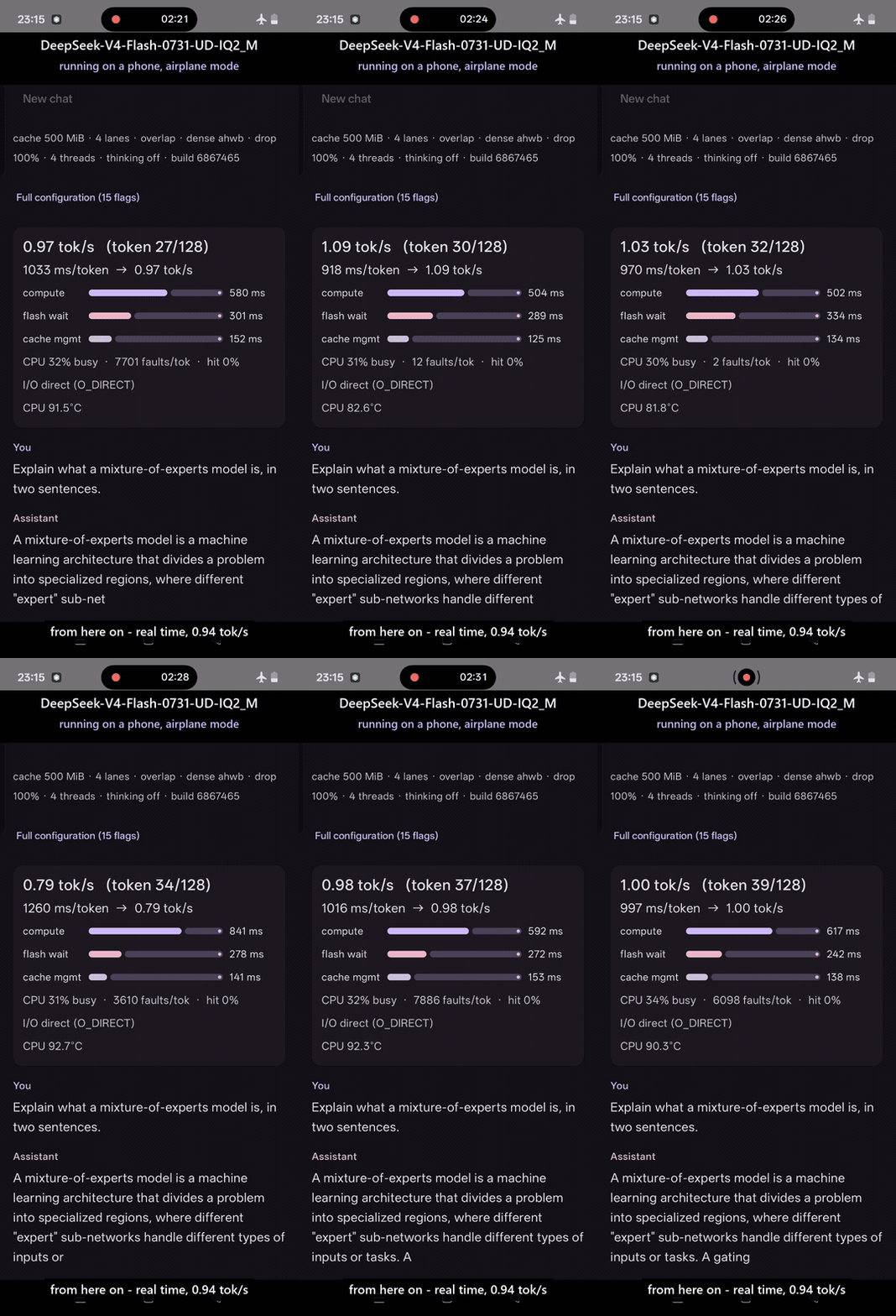
DeepSeek V4 Flash 0731: 284B parameters, ~91 GB on disk, on a 12 GB phone. 0.94 tok/s in the demo app, real time.
It is not one model, either. Below: three of them, one after another on the same phone, each past what it should be able to hold.
https://github.com/user-attachments/assets/f899b93f-c7c4-4ce9-9fb0-5ed1bae13761
Left to right: gpt-oss-120b (~60 GB), Qwen3-30B-A3B (18.5 GB), Gemma-4-26B-A4B (17 GB), recorded in the demo app on a 12 GB phone, real time, not sped up.
Table of contents
- Why this exists
- Try it on your phone
- Features
- Supported models
- Benchmarks
- Quickstart
- How it works
- Documentation
- Prior art
- License
Why this exists
The models people actually want to talk to keep growing faster than the RAM in the devices they carry. MoE models offer a way out, because most of their weights sit idle on any given token, but every mainstream runtime still insists on holding (or paging) the whole file in memory. So a 20 GB model on a 12 GB phone either refuses to load or crawls while the OS frantically swaps.
BigMoeOnEdge treats flash storage as part of the memory hierarchy instead. Three situations where that changes what your device can run:
Models far past RAM. A ~60 GB model on a 12 GB phone cannot be resident, full stop. Streamed, it runs at usable speed. This is the headline case, but it is not the only one.
Models just past RAM. An 18 to 22 GB model on a 12 GB phone is where the ordinary way of loading (mmap) tur