
Needle 2
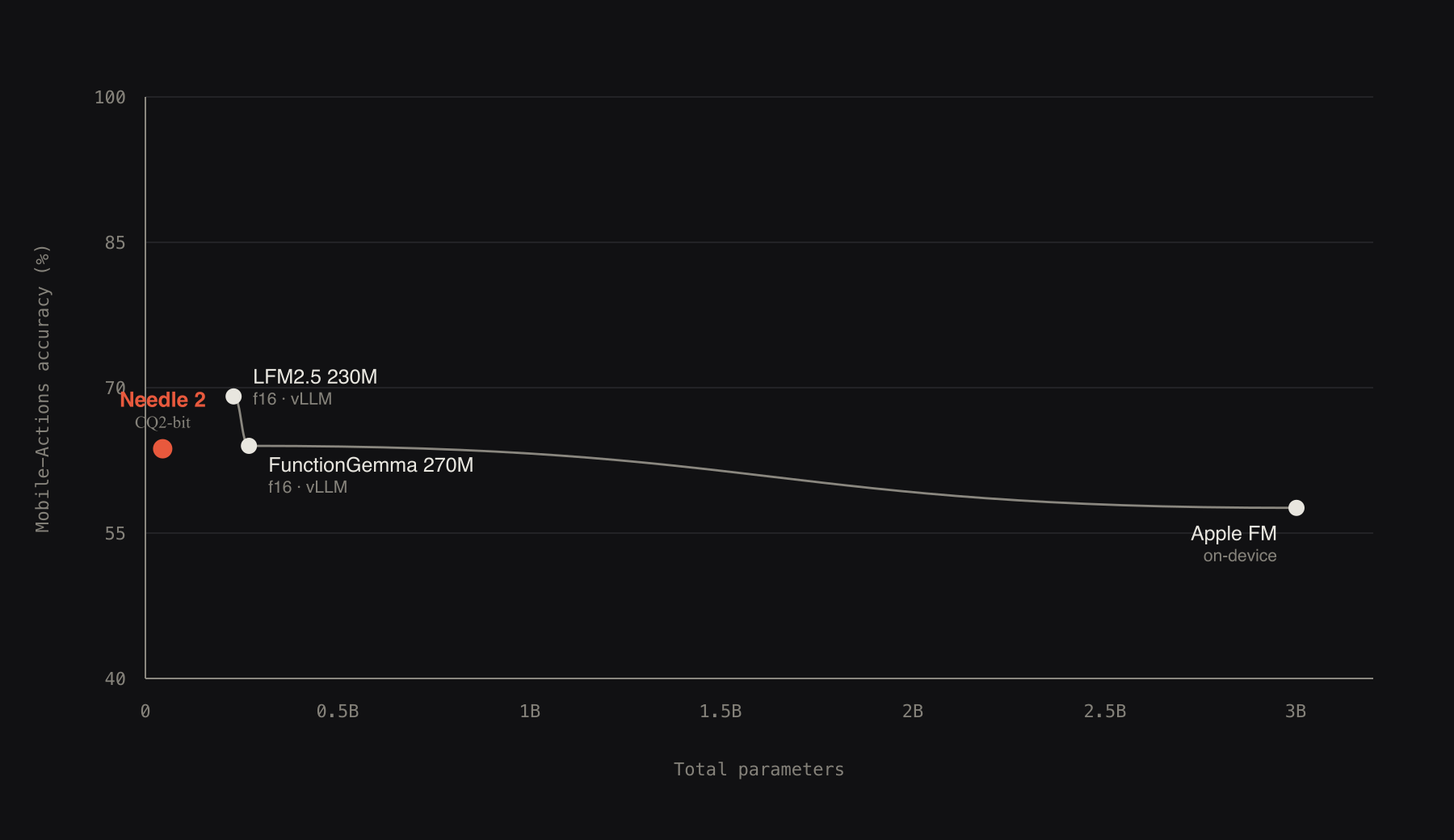
Needle 2 is an open 45M-parameter model for tool calling, device use and structured extraction. The whole model is a single 14MB binary that runs a full session in about 28MB of RAM. It is built on our Simple Attention Network findings, compressed to CQ2-bit with Cactus Quants, and baked into its own engine. On the benchmarks below, Needle 2 trades wins with other small models like FunctionGemma 270M, LFM2.5 230M and Apple FM, at 5x to 70x smaller, and 2 bits against their f16.
This repository is the Python package: inference, LoRA fine-tuning, and export. pip install cactus-needle, describe your tools, and call them from Python. The inference engine is fetched once from Hugging Face and cached; there is nothing else to build, and offline setup for air gapped devices is covered in doc/apis.md.
- Self-contained: weights baked into a single 14MB engine; no separate model files to manage, and inference does no network.
- Simple contract: tool calls come back as structured data, text in, JSON out; a byte-level grammar compiled from your schemas constrains every token.
- Confidence-gated: every response carries a calibrated confidence score from a learned head; set a threshold, act above it, escalate below it.
- Tool retrieval: declare a large catalogue and a built-in retrieval head renders only the top five tools per turn, with the grammar constrained to that subset.
- Bounded memory: a 256-token sliding window with the tools pinned as KV sinks, so total memory stays near 28MB no matter how long the conversation runs.
Weights: huggingface.co/Cactus-Compute/needle2 · source: github.com/cactus-compute/needle.
Simple Attention Network
Needle 2 is a Simple Attention Network, our dense small-model recipe: a Hadamard MLP in place of the FFN, GQA attention, engram key-value memory, and multi-lane hyper-connections. See the paper for the design and ablations: arXiv:2607.18363.
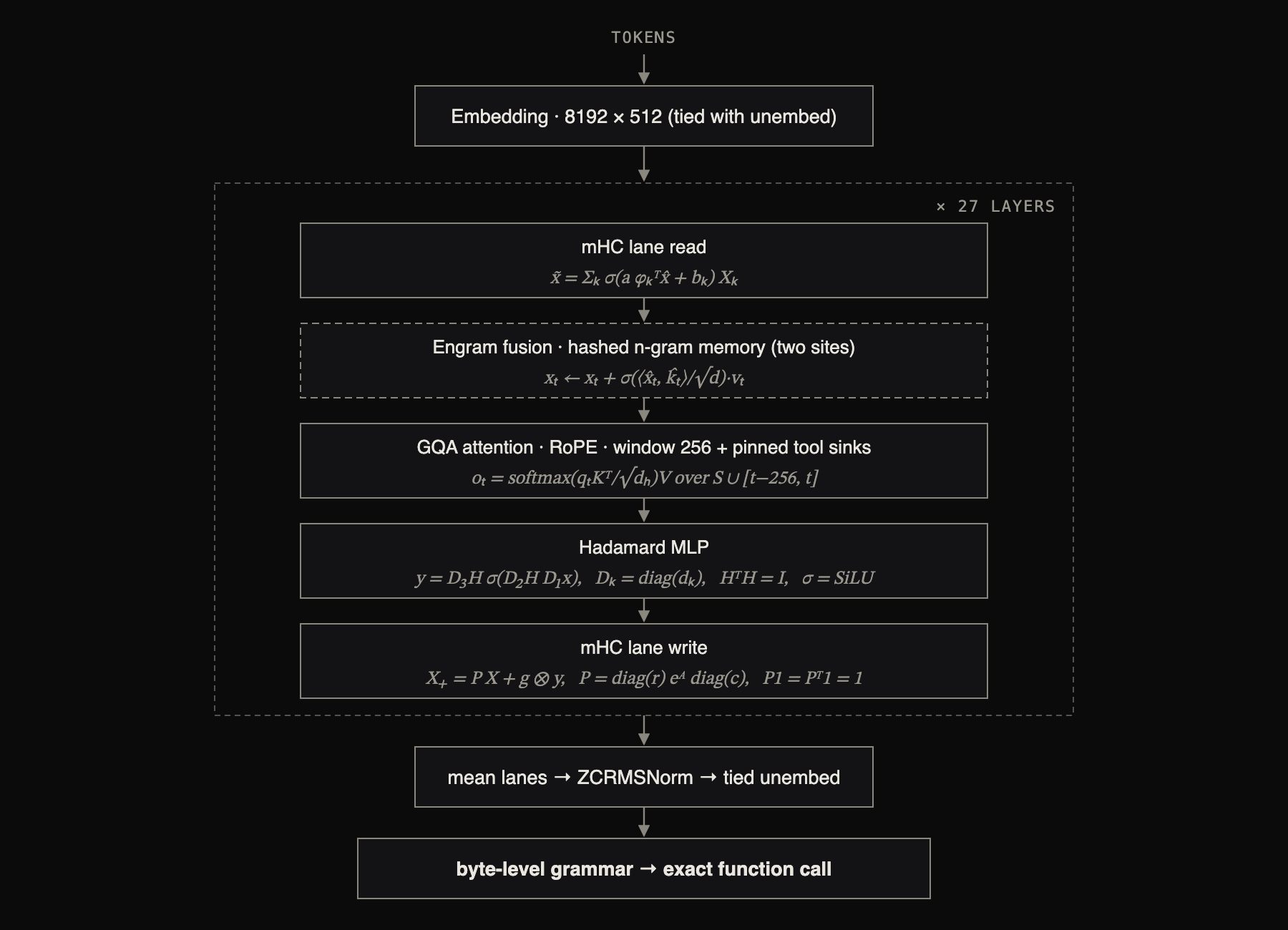
Each block carries its update rule. Here x̂ is the RMS-normalised flattening of the four residual streams, H the orthonormal Walsh-Hadamard transform (a fixed matrix, applied in n log n time with no weights to read), (kₜ, vₜ) rows gathered from hashed n-gram tables, and P the doubly-stochastic normalisation of the routing logits A, computed by Sinkhorn iteration; a, b, g and all σ-gates are learned and input-dependent. Both attention and MLP residuals are sandwich-normed and gated, the engram sites fire at two layers, and decoding is constrained by a byte-level grammar compiled from the declared schemas.
Quickstart
pip install cactus-needle
Needle reads your tool descriptions to decide what to call and how to fill arguments, so describing them well is the whole game.
Simple: decorate a function. The signature gives the argument types, the docstring is the tool description, and run() completes the loop: model picks the call, Needle executes your function, feeds the result back, and returns the final response with the executed tool results attached as results.
import needle

@needle.tool
def get_weather(city: str):
    "Get the current weather for a city."
    return {"city": city, "temp_c": 27, "sky": "clear"}

agent = needle.Needle(tools=[get_weather])
print(agent.run("what's it like in Lagos right now?")["results"])
# [{'city': 'Lagos', 'temp_c': 27, 'sky': 'clear'}]
Extraction: to pull structured data out of text, declare the shape and call extract(). Pass a Pydantic model and you get a typed object back.
from pydantic import BaseModel

class Invoice(BaseModel):
    vendor: str
    total: float
    due_date: str

invoice = needle.extract("Invoice from