README.md2 min read

The open source dark software factory for expert engineers
AI coding agents are powerful but unpredictable. You either babysit every step or review a 50-file diff you don't trust. Fabro gives you a middle path: define the process as a graph, let agents execute it, and intervene only where it matters. Why Fabro?


# With Claude Code
curl -fsSL https://fabro.sh/install.md | claude

# With Codex
codex "$(curl -fsSL https://fabro.sh/install.md)"

# With Homebrew
brew install fabro-sh/tap/fabro-nightly

# With Bash
curl -fsSL https://fabro.sh/install.sh | bash
Then run fabro server start to finish setup in your browser. The server opens a web wizard, exits when the wizard completes, and starts in configured mode the next time you run it.
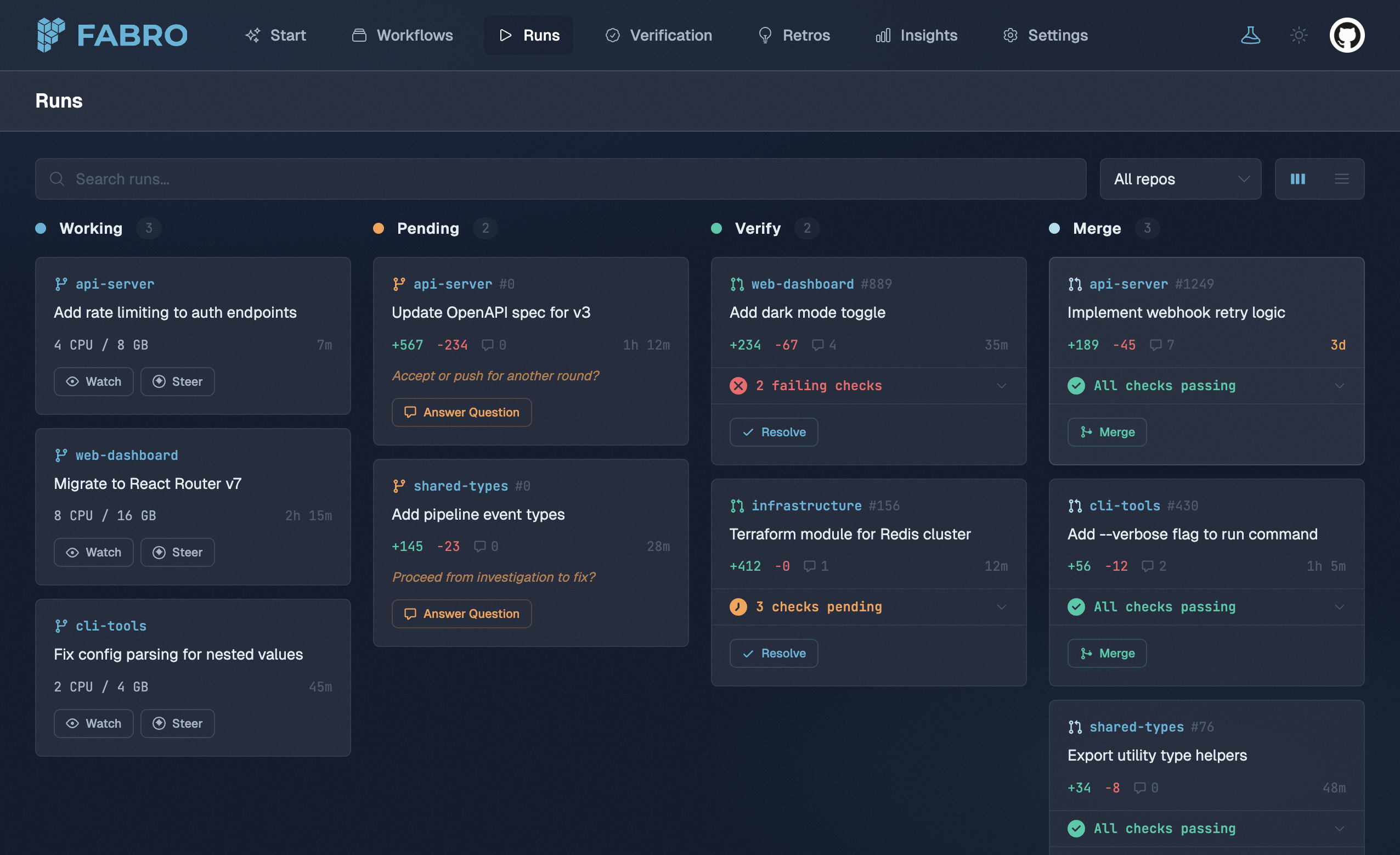
Use Cases
- Extend disengagement time — Stop babysitting an agent REPL. Define a workflow with verification gates and walk away — Fabro keeps the process on track without you.
- Leverage ensemble intelligence — Seamlessly combine models from different vendors. Use one model to implement, another to cross-critique, and a third to summarize — all in a single workflow.
- Share best practices across your team — Collaborate on version-controlled workflows that encode your software processes as code. Review, iterate, and reuse them like any other source file.
- Reduce token bills — Route cheap tasks to fast, inexpensive models and reserve frontier models for the steps that need them. CSS-like stylesheets make this a one-line change.
- Improve agent security — Run agents in cloud sandboxes with full network and filesystem isolation. Keep untrusted code off your laptop and out of your production environment.
- Run agents 24/7 — Fabro's API server queues and executes runs continuously. Close your laptop — workflows keep running and results are waiting when you return.
- Scale infinitely — Move execution off your laptop and into cloud sandboxes. Run as many concurrent workflows as your infrastructure allows.
- Guarantee code quality — Layer deterministic verifications — test suites, linters, type checkers, LLM-as-judge — into your workflow graph. Failures trigger fix loops automatically.
- Inspect every run — Query durable event streams, checkpoints, conclusions, and stage outputs to understand what happened and improve the workflow.
- Specify in natural language — Define requirements as natural-language specs and let Fabro generate — and regenerate — implementations that conform to them.
Key Features
| Feature | Description | |
|---|---|---|
| 🔀 | Deterministic workflow graphs | Define pipelines in Graphviz DOT with branching, loops, parallelism, and human gates. Diffable, reviewable, version-controlled |
| 🙋 | Human-in-the-loop | Approval gates pause for human decisions. Steer running agents mid-turn. Interview steps collect structured input |
| 🎨 | Multi-model routing | CSS-like stylesheets route each node to the right model and provider, with automatic fallback chains |